

How to investigate an isolated elevated ALT – a rational testing approach


Rational testing: In the second of our series on how to rationalise testing in primary care, clinical scientist (biochemistry) Kade Flowers explains a logical approach to investigating a case of an isolated elevated ALT result
Note cases in this series are hypothetical scenarios developed for illustrative purposes
Case: A 54-year-old male patient with type 2 diabetes has been recalled because of an abnormal blood test – the LFTs done as part of his annual review shows an ALT of 74 IU/L (reference limit <41 IU/L), with the other LFTs being normal. Looking back at previous tests you note that in the last couple of years the ALT has been borderline high (around 55), but this is the first time it has been pursued. He is overweight and hypertensive, and takes metformin, dapagliflozin and ramipril. He has no other significant past medical history and says he drinks at most 10U of alcohol per week.
Caution: This article is designed to address predominant elevations of ALT in the absence of red flag symptoms that require immediate referral to secondary care (e.g., weight loss, marked cholestasis, unexplained jaundice). Other patterns of abnormal liver blood tests will not be addressed here.
New names and practice for a new age
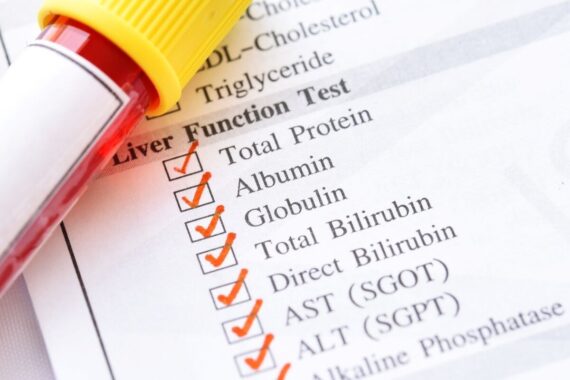
Routine liver function tests (LFTs) typically comprise alanine aminotransferase (ALT), alkaline phosphatase (ALP), bilirubin, total protein and albumin – with the optional addition of aspartate aminotransferase (AST) and gamma-glutamyl transferase (GGT) where appropriate.
Abnormal results more commonly reflect liver damage rather than poor liver function. Consequently, in an effort to be more accurate and avoid undue patient stress, LFTs should instead be more accurately referred to as liver blood tests (LBTs).
In a similar attempt to be more physiologically accurate and reduce stigma, the traditional terms of Non-Alcoholic Fatty Liver Disease (NAFLD) and Non-Alcoholic SteatoHepatitis (NASH) have been renamed Metabolic dysfunction Associated Steatotic Liver Disease (MASLD) and Metabolic Associated SteatoHepatitis (MASH) respectively.1
For more efficient use of pathology services, it may become increasingly common to request ALT on its own rather than as an LBT panel for a first line hepatocellular damage check. As every test has a 2.5% chance of being borderline elevated in a ‘healthy’ patient, this may have the added benefit of fewer clinically insignificant abnormal LBT results requiring follow up.
What are the potential causes of an elevated ALT result?
ALT can be elevated in general intercurrent illness as well as any pathology that causes liver damage. The most common (sometime asymptomatic) causes in the primary care population include:
- MASLD.
- Alcohol associated Liver Disease (ALD).
- Viral hepatitis (e.g., hepatitis B and C).
- Other viral infections (e.g., Epstein-Barr virus [mononucleosis/glandular fever], cytomegalovirus, COVID-19, human immunodeficiency virus).
- Drug induced liver injury.
- Haemochromatosis.
- Autoimmune hepatitis.
Less common causes in the primary care population include:
- Coeliac disease.
- Wilson disease.
- Alpha-1-antitrypsin deficiency.
- Muscle disease (e.g., muscular dystrophy, myositis).
What drugs can cause an elevated ALT?
Although rare, the below medications can cause an elevated ALT.2 For high-risk drugs used long term, it is good practice to determine baseline ALT before they are started (where appropriate).
- Paracetamol.
- Antibiotics (e.g., co-amoxiclav, flucloxacillin).
- Antiepileptics (e.g., valproate, carbamazepine).
- Non-steroidal anti-inflammatory drugs (NSAIDs) – specifically diclofenac.
- Methotrexate.
- Statins (rare – may still have underlying MASLD).
What are the basic minimum, first-line tests to consider for an isolated elevated ALT?
It is common practice to repeat unexpected mildly elevated ALT results before requesting additional investigations. However, as 84% and 75% of abnormal LBTs repeated one month later and two years later respectively are still abnormal,3 this may not be the most efficient investigation process unless the cause is certain (e.g., started a known causative drug or high alcohol intake) or other key LBTs are missing.
Table 1 outlines the key LBTs and table 2 the minimum first-line investigations that should follow an unexpected elevation of ALT.
Table 1: Key liver blood tests for an elevated ALT
Investigation Use Considerations ALT ↑ in hepatocellular damage. Not entirely liver specific (also ↑ in muscle damage and haemolysis). AST Bilirubin ↑ in cholestasis, haemolysis and reduced liver function. ALP ↑ in cholestasis. Not liver specific – also ↑ in vitamin D deficiency (measurement rarely required), hyperparathyroidism, bone metastasis, growth in young age (all bone origin), and pregnancy (placental origin). GGT ↑ in cholestasis and high alcohol intake. Also ↑ in hepatocellular damage but to less of a degree. Also ↑ in other drug use, particularly anti-epileptics. Albumin ↓ in reduced liver function. Not liver specific – also ↓ in infection/inflammation, pregnancy, malnutrition, malabsorption and renal disease. INR ↑ in reduced liver function. FBC ↓ platelets in moderate/severe liver fibrosis. Platelets also ↓ in high alcohol intake.
ALT, alanine aminotransferase; AST, aspartate aminotransferase; ALP, alkaline phosphatase; GGT, gamma-gluamyl transferase; INR, international normalised ratio; FBC, full blood count.
Table 2. Key minimum first line investigations for an isolated elevated ALT (non-invasive liver screen).
Investigation Use Considerations Liver ultrasound Structural assessment. HbA1c ↑ in diabetes – risk factor for MASLD. Can be misleading if anaemic or a haemoglobinopathy – consider fasting glucose criteria instead. Lipid profile ↑ triglycerides and ↓ HDL-C in metabolic syndrome – risk factor for MASLD. Fasting not routinely required. Total cholesterol and LDL-C may be normal or ↑. Transferrin saturation and ferritin Both ↑ in haemochromatosis. Ferritin can be falsely ↑ in infection/inflammation and high alcohol intake. Liver autoimmune panel Diagnosis of AIH, PBC, PSC, etc. Not 100% sensitive or specific. Immunoglobulins May help to differentiate AIH (↑ IgG), ALD and cirrhosis (↑ IgA), and PBC (↑ IgM). Pattern of increase may not be a reliable differentiator. Hepatitis B surface antigen Hepatitis B infection diagnosis. Detects current acute or chronic infection. Hepatitis C antibody Hepatitis C exposure identification. Cannot differentiate past from current infection therefore a positive result should be followed up by PCR to confirm current infection. Fib-4 score Non-invasive risk assessment of advanced liver fibrosis. Only for suspected MASLD based on risk factors and pattern of abnormal LBTs (isolated ↑ ALT makes MASLD more likely).
MASLD: Metabolic dysfunction associated steatotic liver disease; HDL-C, high-density lipoprotein cholesterol; LDL-C, low-density lipoprotein cholesterol; AIH, autoimmune hepatitis; PBC, primary biliary cholangitis (formerly primary biliary cirrhosis); PSC, primary sclerosing cholangitis; ALD, alcohol related liver disease; PCR, polymerase chain reaction; LBTs, liver blood tests.
What are potentially helpful additional tests to consider for an elevated ALT?
The extent of additional investigations ultimately depends on the clinical context, including family history, risk factors and age. Table 3 shows some additional investigations that may be appropriate in some situations but should not be done in every case of an elevated ALT.
Table 3: Potentially helpful investigations for an elevated ALT depending on the clinical context.
Investigation Use Considerations Creatine kinase ↑ in muscle damage. Only if there are symptoms of muscle disease. Severe disease is expected if muscle origin is the cause of an elevated ALT. Copper and caeruloplasmin Both ↓ in Wilson disease. If patient is <40 years old with relevant symptoms and/or family history and table 2 investigations are not conclusive. Alpha-1 antitrypsin ↓ in alpha-1 antitrypsin deficiency. Only if relevant family history and/or table 2 investigations are not conclusive. Can be falsely ↑ in inflammation/infection. Anti-TTG ↑ in coeliac disease. Only if relevant symptoms and/or family history. TSH ↑ in hypothyroidism, ↓ in hyperthyroidism. Only if symptomatic.
TTG, tissue transglutaminase; TSH, thyroid stimulating hormone.
What should be the next step for this patient’s elevated ALT?
The relatively little alcohol intake with isolated elevated ALT and obvious metabolic risk factors (e.g., type two diabetes and hypertension) makes MASLD the most likely cause.
As per the British Society of Gastroenterology (BSG) guidance,4 all investigations in table 2 should be arranged and the fibrosis 4 (Fib-4) score should be calculated. The investigations in table 2 would unlikely show an alternative explanation for the isolated elevated ALT, therefore the BSG MASLD pathway can be followed based on the Fib-4 score (table 4):
Table 4: Actions based on the fibrosis 4 score for suspected MASLD.4
Fibrosis 4 (Fib-4) score Interpretation for advanced fibrosis Action ≤ 1.30 (<65 years old) ≤ 2.00 (≥65 years old) Low risk. Manage in primary care. 1.31 – 3.25 (<65 years old) 2.01 – 3.25 (≥65 years old) Indeterminate risk. ELF test or Fibroscan to categorise as low or high risk. > 3.25 High risk. Refer to hepatology clinic.
ELF, enhanced liver fibrosis
If low risk, the patient should be managed accordingly by offering weight loss advice and appropriate management of their type two diabetes and hypertension. The Fib-4 score should be monitored every 2-5 years depending on the clinical risk and managed according to table 4.
What tests are often done in this scenario but are not appropriate?
It is essential to consider the clinical context when requesting investigations for uncommon conditions. For example, the investigations in table 3 are not required in this case as the likely cause of MASLD can be elucidated from the clinical history and LBT abnormality pattern alone.
Every test has a risk of misguiding patient management and incurs cost, therefore additional investigations other than the ones in table 1 and table 2 should be requested only when the pre-test suspicion of that particular condition is high.
Kade Flowers is Clinical Scientist (Biochemistry) at University Hospitals Sussex NHS Foundation Trust
References
- Rinella M et al. NAFLD Nomenclature consensus group. A multisociety Delphi consensus statement on new fatty liver disease nomenclature. Hepatology 2023;78:1966–1986
- de Abajo F et al. Acute and clinically relevant drug-induced liver injury: a population based case-control study. Br J Clin Pharmacol 2004;58:71-80
- Lilford R et al. Birmingham and Lambeth Liver Evaluation Testing Strategies (BALLETS): a prospective cohort study. Health Technol Assess 2013;17:1-307
- Newsome P et al. Guidelines on the management of abnormal liver blood tests. Gut 2018;67:6-19
Visit Pulse Reference for details on 140 symptoms, including easily searchable symptoms and categories, offering you a free platform to check symptoms and receive potential diagnoses during consultations.
Related Articles

READERS' COMMENTS [6]
Please note, only GPs are permitted to add comments to articles







Written by a Biochemist not a doctor
Don’t forget to examine the patient ! And what about an ultrasound ?
I’m sure I’m causing great harm through the opportunity cost of investigating all this. Probably best off telling him he’s probably got fatty liver disease and make sure we’re doing all we can about his diabetes, weight and alcohol use.
thats at least 10 patients per day ………
High risk of unnecessary over investigation. Not written with clinicians in mind.
A couple of key questions here:
1. 54 year old diabetic but not on a statin?
2. If not on a statin why are we testing the LFTs?
3. Statistically given his age he is 30% chance of fatty liver, overweight with diabetes he 100% has fatty liver, surely weight loss and recheck in a few months is the way to go?
4. Looking forward to the follow up articles on what to do when the FBC is mildly abnormal and albumin is a bit low, and the iron studies and ferritin are slightly off, and the ultrasound shows a simple cyst and diffuse fatty changes, the non fasting triglycerides are slightly outside normal range and the eGFRis <90.
Perfect. Perhaps im ordering too many alpha 1 antitrypsins lol
Theyre 99% MASLD