Complex asthma in primary care: managing preschool wheeze


In the next in our miniseries on complex asthma, paediatric respiratory specialist Dr Cara Bossley provides an overview of management of wheeze in preschool children, including potential triggers, how to diagnose without objective tests and the prognosis when appropriately managed
What is the difference between preschool wheeze and preschool asthma?
While some guidelines still describe them as distinct conditions, the terms preschool wheeze and preschool asthma can be used interchangeably; it is not essential to differentiate between these. A recent Lancet commission which brought together international experts, recommended that the term ‘asthma’ be viewed as a descriptive label for symptoms rather than an indication of the underlying cause. The priority is to determine which treatment a child responds to. Administering a bronchodilator during an acute episode is useful for assessing response and as discussed later, a trial of inhaled corticosteroid (ICS) is important to indicate steroid response.
When should we suspect preschool wheeze?
A diagnosis of preschool wheeze should be suspected in preschool children who have recurrent (two or more episodes) of confirmed wheeze. Alongside this wheeze there may be shortness of breath and/or a dry cough.
In addition, it should be suspected if children have persistent symptoms of wheeze, cough and/or shortness of breath without infections, sometimes when they exert themselves playing or if they are exposed to allergens.
It is a good idea to check if there is symptomatic response to bronchodilators, which in this age group will often be ascertained by history alone. If a child is seen in A&E with wheeze, then a positive bronchodilator response may be seen.
A previous history of allergies, allergic rhinitis or eczema is also important in this group as it increases the likelihood they have asthma.
It is important to always exclude other diagnoses. For example, if there is a wet cough or clubbing this would alert us to an alternative diagnosis such as protracted bacterial bronchitis, or more rarely bronchiectasis or cystic fibrosis.
Historically, clinicians attempted to distinguish between viral-induced wheeze and multi-trigger wheeze, but growing evidence shows significant overlap between the two. In many cases, one pattern may evolve into the other over time, making these classifications less clinically useful.
What causes preschool wheeze?
Wheeze in preschool children usually occurs due to the combination of a genetic susceptibility and environmental exposures. So, for example, if a child has a genetic predisposition and then contracts a viral infection in their early years this can lead to the development of persistent preschool wheeze.
More specifically, variants in a region on chromosome 17, locus 17q, are associated with preschool wheeze and childhood-onset asthma. These genetic variants usually interact with the environment to influence the risk of asthma; children with variants at this locus who are then exposed to viruses such as rhinovirus are more likely to go on to have asthma. Similarly, tobacco smoking during pregnancy is a big risk factor for preschool wheeze and the risk is increased by variants at this locus.
Children with eczema, atopy or food allergies are also more likely to develop preschool wheeze. Exposure and subsequent sensitisation to allergens can contribute to the acquisition of asthma.
Pollution in the environment can also interact with certain genetic loci and increase the likelihood of development of preschool wheeze.
Obesity has an impact and alongside reduced physical activity can contribute to the development of preschool wheeze and subsequent childhood asthma.
What are the potential triggers for wheeze in this age group?
Wheeze in preschool children is usually triggered by viral infection (such as rhinovirus, respiratory syncytial virus or influenza). Rhinovirus is identified as the most prevalent causative agent, accounting for approximately 30–40% of wheezing episodes in preschool-aged children.
Allergens like tree and grass pollen, house dust mite and animals can all trigger wheeze attacks. It is important to identify such triggers early so they can be avoided. Exposure to tobacco smoke and pollution can also trigger attacks.
Exercise and physical exertion can also trigger wheezing in preschool-aged children, so it’s important to ask whether symptoms occur with activity or are solely associated with viral infections.
Is there any testing we can do on this age group, or is it a purely clinical diagnosis?
Diagnosis in preschool children is mainly clinical, and a careful history is paramount. Specifically, it is important to check that there is wheeze present. If the child does not wheeze in the consultation, playing a video or audio recording of true wheeze, or asking the parent to record the child’s sound for the GP to check, can help to distinguish true wheeze from upper airway sounds or cough.
It is important to remember that isolated dry cough is rarely due to wheeze. The timing of onset is also important, as wheeze rarely occurs from birth and this is more suggestive of a structural abnormality such as bronchomalacia.
It is also important to look out for other red flags such as unilateral wheeze, which could be a sign of an inhaled foreign body, or clubbing which could indicate bronchiectasis or cystic fibrosis.
Any of these signs warrant a referral to a paediatric respiratory specialist.
It is difficult for preschool children to perform any objective testing – spirometry and fractional exhaled nitric oxide (FeNO) measurement are tricky for younger children. The NICE/BTS/SIGN guidelines suggest that these should only be attempted from 5 years of age.
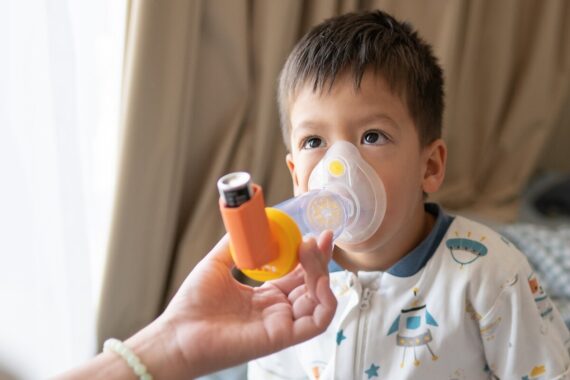
A trial of 8-12 weeks of a metered dose inhaler of low-dose ICS with an appropriately sized spacer can help with making the diagnosis. If symptoms resolve and then recur when it is stopped, preschool wheeze is likely.
If a child is atopic and having frequent and problematic attacks of wheeze, allergy testing can be helpful to identify triggers for attacks, and elements in a child’s environment that may be driving inflammation. Sometimes simple measures to remove such allergens can make a big difference.
How should we treat these children?
If a response to ICS is observed after the trial, adjust the dose to achieve the desired effect. This may be up to a moderate dose of ICS if needed. Note that ICS is not disease modifying, so it will not prevent the course of the disease but will reduce the symptom burden and number of acute exacerbations. A short acting bronchodilator should also be given for rescue use. While on ICS treatment, review the patient regularly to ensure they are on the minimum but adequate dose of ICS.
If the symptoms do not resolve with the trial of ICS, then it important to do 3 things: (1) check inhaler technique and adequate adherence; (2) check the environment for triggers; and (3) review if an alternative diagnosis is present. If none of these explain the failure of response, then referral to a specialist in paediatric asthma is recommended.
In preschool wheeze with uncontrolled symptoms and multiple attacks, a leukotriene receptor antagonist could be considered.
What is the prognosis – how likely is it that the child will ‘grow out of it’?
Wheeze is very common at preschool age, affecting around 30-40% of children by the age of 5 years.
Many children will grow out of wheeze and studies suggest that only around a third to a half of children with preschool wheeze have asthma at 6 years of age.
It is important to note that giving treatment with ICS will not affect the development of persistent asthma in at-risk children. It will treat the symptoms and reduce the frequency and severity of wheeze. There is, however, some evidence that preschool children who have frequent and severe attacks will have impaired lung function trajectories from childhood into adulthood, so giving appropriate treatment is important.
Atopic children are less likely to outgrow wheeze, however. Also, having a mother or father with asthma, eczema or allergic rhinitis is a risk factor for later asthma. A child with one parent who has asthma is 3-6 times more likely to develop it. This is probably related to a mixture of genetics and environment the family shares.
Tobacco smoke exposure in pregnancy and in childhood gives a higher likelihood of later asthma, and children should be protected from such toxins to prevent this.
Obesity and unhealthy eating habits can also increase the risk of developing asthma later in life, whereas a Mediterranean diet can be protective. It is important that families are educated and encouraged for their children to have healthy lifestyles.
Dr Cara Bossley is consultant in paediatric respiratory medicine at King’s College Hospital, London
Sources and further reading
- Pavord I et al. After asthma: redefining airways diseases. Lancet Commissions. Lancet 2018; 391(10118):350-400
- Makrinioti H et al. European Respiratory Society statement on preschool wheezing disorders: updated definitions, knowledge gaps and proposed future research directions. Eur Respir J 2024;64(3):2400624
- Wolters A et al. Genetics of preschool wheeze and its progression to childhood asthma. Pediatr Allergy Immunol 2024;34:e14067
- Stein et al. A decade of research on the 17q12-21 asthma locus: Piecing together the puzzle. J Allergy Clin Immunol 2018;142(3): 749-64
- NICE. Asthma: diagnosis, monitoring and chronic asthma management (BTS, NICE, SIGN). [NG245] 2024
Visit Pulse Reference for details on 140 symptoms, including easily searchable symptoms and categories, offering you a free platform to check symptoms and receive potential diagnoses during consultations.