
GPs forced to ‘undo’ incorrect AI information patients read, says chief medical officer
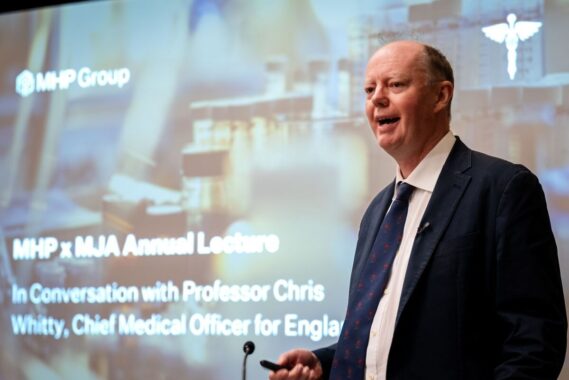


GPs are increasingly having to start their consultations by ‘undoing’ incorrect information that AI has provided to patients, Professor Sir Chris Whitty has warned.
Asked about the public’s use of AI large-language models (LLMs) such as ChatGPT to explain their symptoms, England’s chief medical officer said they are prone to giving incorrect information in place of ‘admitting’ uncertainty.
Speaking at a Medical Journalists’ Association event last week, Professor Whitty said: ‘We are at a particularly tricky point, because people are using them (LLMs) – that’s a reality.
‘The problem is that the models are not good enough to deal with quite large numbers of the problems that people face, particularly if they’ve got multimorbidity or a rare disease, or they come from an ethnic group which has a different disease pattern.
‘Unfortunately, most of the large language models are remarkably bad at saying “I don’t know”, or “I’m not sure about that, there’s a 10% probability that my answer is right but there’s a 90% probability that it isn’t”’.
‘At this point, the danger is you’ve got certainty, and models which are often both confident and wrong, and that is tricky because GPs, for example, who have often got a very short time, are faced with someone who’s been given incorrect information via an LLM and then has to undo the incorrect information.’
Professor Whitty said it contrasted with the standard in Government and the medical profession, in which ‘we put levels of uncertainty on the information we give’ to the public.
He clarified that he expected the models to ‘get a lot better’ in future and that ‘their accuracy will improve’, but that currently ‘we don’t know which’ AI-produced answers are accurate.
It comes amid Government plans to introduce an AI-enabled ‘GP in your pocket’ feature of the NHS app to handle non-urgent care enquiries by 2028. A recent Health Foundation analysis suggested the feature could face resistance from patients.
At the event, he was also asked about the how medical journalists can cover the debate around prostate cancer screening.
Last year, the UK National Screening Committee (NSC) said it would advise against routine NHS prostate cancer screening but said there is evidence screening should be considered for men with faulty BRCA genes. The committee had come under pressure in recent months to reconsider PSA testing policy.
Professor Whitty said it was ‘very important that the debate around screening is done in a sensible and pragmatic way’.
‘Some people who are not screened and then get an early prostate cancer will wish they had had screening. Some men, we know, wish they had not gone for screening, because they’ve now got side effects that they were not expecting to live with, and they don’t know whether that was going to cause them a benefit.
‘It is perfectly legitimate that three people looking at the same data might come to different conclusions’, he said.
Pulse found that a quarter of GPs are ‘strongly supportive’ of the NHS introducing prostate cancer screening, but many highlighted issues with current PSA testing.
Professor Whitty also spoke about how demographic changes would inform the medical profession’s approach to public health.
He said an increase in multimorbidity meant doctors must be able to provide holistic care.
‘At every age, people who are living in deprivation have twice the level of frailty of people living in other areas. This is completely preventable. This is also true for multimorbidity … If you delay multimorbidity, it would make an enormous difference to people’s independence, quality of life, their family’s independence, and indeed, the pressures on the NHS.
‘The response of the medical profession to a population that’s becoming more and more multimorbid, where someone has several conditions at once, is to become more and more specialist.
‘This is a conversation we’re having in the medical profession: we need to move back to a situation where people maintain their generalist skills, so they don’t just deal with the one thing that is their specialty, but they can also deal with all the things that interact around that.’
Professor Whitty had recommended placing a stronger focus on all doctors having more generalist knowledge in the report he co-authored last year as part of a major medical training review.
Visit Pulse Reference for details on 140 symptoms, including easily searchable symptoms and categories, offering you a free platform to check symptoms and receive potential diagnoses during consultations.