

GPs need to ‘get with the 21st century’ on online access, says health secretary
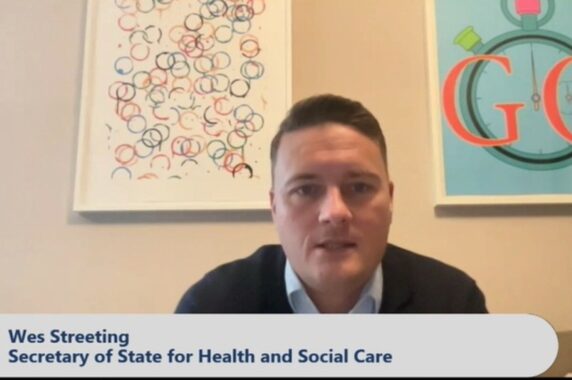


Wes Streeting has defended 1 October contract changes on online access, arguing they are achievable but some GPs just ‘don’t like’ them and have decided not to engage.
Taking questions at the BMA’s special representative meeting on the 10-year NHS plan this morning, the health secretary was pushed on whether he would engage with the BMA’s GP Committee to avoid a dispute with the profession.
During the exchange, via video link with BMA chair Dr Tom Dolphin, Mr Streeting denied that the contract changes on keeping online systems, telephones and doors open through core hours are being imposed, and he argued that although they are achievable and unavoidable, ‘some GPs’ just don’t ‘like’ them.
The health secretary said the next step now would be to work with NHS England to support practices who struggle to implement the changes.
He said: ‘We want to do everything we can to support practices in terms of the change to online access from 1 October, and we gave a longer lead in time, pushing back from April to October in order to be able to achieve that.’
‘I think we will now be working with NHS England to identify those practices that are struggling to meet that deadline and to understand why. We see this right across the NHS – people are in different starting points, and in any kind of reform or change program, you’ll have your leaders, and you’ll have your laggards, and you’ll have people with different legacy systems. So where there are those kind of practical obstacles, we want to understand that.’
However, he appeared to take a hard line on practices who oppose the changes, on non-IT technical grounds.
He told the meeting: ‘I’ll be honest, though, that there are sections, and I wouldn’t overstate this, or exaggerate the scale of this, there are sections of general practice, or elements of general practice that just don’t agree with the change, don’t think it’s desirable, and have just taken the “we’re not doing this” approach.
‘In fact, the practice I just mentioned and I visited the other week, who are way ahead of the pack, have been offering to help other practices, sharing their experience of changes to online practice and their back-office systems and the way in which that’s improved the experience not just of patients, but doctors. Some people have bitten their hands off for that help because they need it. Others said: “oh no, we’re not bothering with that”.
‘And I’m afraid it’s the “we’re not bothering with that” I have a problem with – not least because I think it is extraordinarily naive and self-defeating if we think in this decade of the 21st century that we can just stay with outdated approaches to how people access, engage with and interact with their public services. That’s where I think some of the laggards – who don’t have the excuses of legacy systems – need to kind of get with the 21st century, because the public just will not tolerate being forced to queue up outside of practices or wait on hold at eight o’clock in the morning, or engage in the equivalent of a lottery to get a GP appointment when they’re worrying.’
However, Dr Dolphin pushed back on the suggestion that GPs were just not bothering, reminding Mr Streeting of the real risk of a contract dispute over the issue. As reported by Pulse, several LMCs have urged the BMA to enter dispute with the Government over the issue, which will be debated at a GPC meeting on Thursday (18 September).
Dr Dolphin told the health secretary: ‘I don’t think it’s that GPs are not bothering. I think it’s a question of managing the demand that’s coming through safely in a system that is so stretched and their concerns that the online access system that is being imposed is preventing them from doing that safely. Can you, can you agree that you will speak to GPC to try and avert a dispute on this? Because I think this is something we all want to avoid, if we can.’
To which Mr Streeting said: ‘Yeah, very, very much. So I’m very happy to talk to GPC about it, but we have, you know, there has been considerable amount of time, and look when you say impose, Tom, this was agreed. And secondly, it is a good change. You know, to be able to have modern services for patient access and triage will deliver a better experience for everyone. I think some believe that more than others. So we got a lot of work to do, but we can, we can do this together, and I’m very happy to work with GPC.’
Mr Streeting also urged doctors to ‘recognise’ the leadership of the GPC during the exchange.
He said: ‘So, you know, I think we’ve actually worked well with GPC. They do not pull their punches, and sometimes we’ve had some very robust discussions and disagreements. But ultimately, I think things have already moved on in a positive direction. In general practice, in the first year, I accept there is so much more to do, and that will become a recurring theme of our relationship in the coming years, there will always be more to do, but we’re off to a good start. And you know, I think it’s really important that that that leadership is recognised.’
His comments come as it had been suggested GPC chair Dr Katie Bramall could face a vote of no confidence at the 18 September meeting – relating to negotiating mistakes over the 1 October contract changes – although Pulse now understands this is unlikely to take place.
Ahead of the Q&A, Mr Streeting gave an address to the BMA SRM, during which he urged the doctors’ union to work with the Government rather than going into dispute. He said he felt the Government had a good relationship with the BMA but also accused the union of not having taken ‘the olive branch’.
He said: ‘My door’s always open. I’m always at the other end of the phone. I’m always willing to get around the table, and there are not many people outside my department who I’ve spent more time with over the last year than representatives of BMA. If I’m honest, though I’m still waiting for the BMA to take the olive branch.’
He also warned of what would happen if doctors and Government could not work together, arguing that it would pave the way for Nigel Farage’s Reform party.
He said: ‘I’ve got to say, and surely you must see this, there isn’t a more pro-NHS, pro-union, pro-doctor health secretary waiting in the wings. Lord Darzi said that it’s reform or die for the NHS, and if we fail, and Nigel Farage gets his hands on it, then it’s reform and die. I don’t know about you, but I don’t want that on my conscience.’
Signing off the call with the meeting, Mr Streeting again urged BMA doctors to avoid industrial action and strikes.
He said: ‘I want to end with a note of thanks, because I genuinely do appreciate what your professions give to our country and to our National Health Service, and I know we can’t do this without you, and I think those are grounds for us to work well together and to work through disagreements together without the need for dispute and industrial action.’
Related Articles

READERS' COMMENTS [21]
Please note, only GPs are permitted to add comments to articles






What is there for the deaf ? Trying to run telephone consultations with your doctor or negotiate with practice staff over the phone if you are hard of hearing is really difficult – Is the NHS system going to embed a speech to text for patients ?? Then what about if you have poor sight and can’t read ?
Will that be coming with some 21st century funding?
What about those who struggle with IT?
Tell them ‘ get with the 21st century’?
Simple fact is demand far outstrips what general practice can cope with
Cynical use of “fear of Reform” by Wes-in-shorts, instead of offering the enheartening hope of a good alternative story, well told.
2 things appear to drive Comedy Wes’s political positions – not losing his “528-vote” seat so that he keeps his MP income and expenses (hence, self-servingly, strong statements on Gaza); failing that, keen on the uniparty Blairite approach of looking after the corporate interests of IT, capital, construction and Pharma etc in the NHS. This’ll be, self-servingly, handy should he lose his seat – he’ll still get revolving door employment from one of those corporates.
I don’t like his use of political rhetoric, nor Labour’s dishonesty, nor trust them with the NHS. Represent the people’s interests, or change your name to the Capital Party..
Some friendly advice Wes,from a GP leaving the country very soon, spin and rhetoric only gets you so far at somepoint you need to actually do a good job rather than just spin it and hope no one notices. People do care about GP access but complex triage systems that result in lots of GP time being spent triaging and consequently less consulting is unlikely to win you a great deal of support.
Agreed – on the whole default f2f appointments ( but offered phone if needed) are best in terms of clinical safety, accuracy and popular with patients ( if that’s what you’re interested in, which it should be) . Many patients do not like complex clinical electronic triage- what’s the point when you just have to go over the story again with a clinician? It wastes a lot of time and there is a huge amount of duplication of work..the most efficient and safest system on the whole is face to face consultations.
The main problem is unrelenting increasing demand, seen through all health systems, not just the UK.
But the UK is trying to meet that demand through rules and regulations rather than stumping up the resources required, at least for primary care. They are happy to spend loads of money on secondary care.
If you want to meet demand you need to seriously look at the quantity of work done in primary care and have a system to match that to funding. Otherwise you are always going to lose. It’s not that expensive when compared to the wider NHS, brings in satisfaction more effectively then spending money elsewhere and saves money through the health system in a way that is cost effective.
Pull your finger out Wes.
The GP remuneration is still in the 3 consults per year range and most are up to nearly 6 consults per year. This system stokes more demand without any more resources. Of course if they paid us per consultation so you know payment by results like the hospital then it may change. More doors on a bus with no more seats does not improve how many can use the bus.
What cannot be changed is the number of hours in a day.
With 40+ years experience I think I can safely manage about 7 to 8 hours of consulting spread over a working day. That can be f2f, telephone, home visits or e consults. If I have to spend more time to triage e consults then that is less time available for other types of consulting. The Health Secretary needs to grasp that GP’s cannot keep trying to force a quart load of demand into the pint pot of availability.
The Inverse Care Law in Government-Approved Action !
Why should GPs leave half our patients behind in the last century just to waste money on stuff that still needs to be proven !
Dear Editor,
As a GP who has devoted decades of service to the NHS, I write with a profound and burning sense of betrayal at Health Secretary Wes Streeting’s defence of the 1 October contract changes. These dictate that practices must keep online systems, telephones, and doors open throughout core hours. His glib dismissal of GPs who resist as mere “laggards” who “don’t like” modernisation is not only an insult to our profession. In fact, I believe, it is a dangerous caricature that imperils patient safety.
This digital-first decree threatens to substitute hasty remote encounters for careful, hands-on medicine, reducing the living art of clinical practice to little more than an access metric. Worse still, it overlooks the troubling role of those colleagues who, seduced by financial inducements, leaned into this model, while others of us bore the full burden of unrelenting face-to-face care. Let us be clear: this is not reform, it is a reckless imposition that violates evidence, ethics, and the very essence of medicine.
Physical examination is not a luxury, but it is the bedrock of diagnosis. No algorithm, no video call, no telephone line can replace the palpation that detects an abdominal mass, the auscultation that reveals a murmur, or the reflex hammer that unmasks neurological disease. The science is stark: telemedicine achieves diagnostic concordance with in-person assessment as low as 86.9%. That means more than 13% of patients risk misdiagnosis. A gamble no ethical physician should accept. Yet this policy risks forcing practices into inadequate remote triage under the guise of efficiency, pressuring GPs to compromise where compromise is intolerable.
And what of the human dimension? The doctor–patient encounter is a sacred space, where subtle signals, the faltering gait, the pallor of anaemia, the silent cry of distress, speak volumes. Such nuances vanish into the pixelated void of a video call. Ninety per cent of clinicians report difficulty in building trust remotely; the cognitive strain is heavier, the risk of error higher. To flood practices with unchecked online requests, without safeguards of time and capacity, is to invite a collapse in quality. It betrays patients who need to be seen not as data points, but as human beings. Even the GMC is unambiguous: remote consultations are acceptable only when they truly meet a patient’s needs, and doctors must escalate to in-person when required. To compel otherwise is to coerce clinicians into betraying their duty.
Nor can we ignore the injustice. Elderly patients, the rural poor, the digitally excluded. All risk being cast aside by a policy that prizes convenience over compassion. Equity and informed consent, cornerstones of our practice, are endangered when practices (already stretched to breaking point) default to remote tools simply to survive. And again, my frustration intensifies at colleagues who, tempted by short-term incentives, acquiesced. Their silence has been mistaken for consent, paving the way for this dictat that now threatens to hollow out our vocation.
Mr Streeting’s invocation of Nigel Farage and Reform as some looming spectre is a diversion, a theatre trick. The true danger is a “reformed” NHS that sacrifices science to statistics, substance to slogans, quality to quotas. GPs are not obstructive, nor idle. We are standing in defence of an NHS faithful to evidence, to ethics, and above all, to the patients we serve.
I call upon the BMA and any other clinical body: reject this imposition outright. If necessary, enter dispute. Demand revisions that put patient safety, professional integrity, and human dignity above political expediency. For medicine is not a marketplace, nor a management spreadsheet, but it is a covenant between doctor and patient. And that covenant must never be broken.
Sincerely,
Edoardo
Wow Edoardo – absolutely spot on- thank you 🙏
Amen to that EC. Well said..
BMA, take note and act to publicise and call a protest march before it all disappears in the mists of time…
It is frustrating that general practice is being told we must handle all demand on the day, with no additional resources, while secondary care is allowed to extend waiting lists for routine care from 3 months to 12 months in specialties like ENT, orthopaedics, and gastroenterology.
We absolutely support modernising access, but there is a stark double standard here: when hospitals struggle, the system adjusts expectations; when GPs struggle, the system raises them.
Without parallel investment in workforce, estates, and IT, asking practices to manage every call that comes through daily is not only unrealistic but unsafe. Patients deserve timely access in both primary and secondary care. What they are actually experiencing, however, is shrinking hospital capacity combined with increased pressure on general practice to pick up the slack.
If the Government wants reform to succeed, it has to be honest about this imbalance and provide genuine, funded support — not just rhetoric about “laggards”.
I’m glad EC put it so brilliantly – my brain is dead after a full day in the trenches. Has the health secretary ever been in a GP appointment? There is so much going on that e consults will never be a substitute. Patients just won’t believe some discombobulated voice on an email – this is not health care. What about the doctor as a drug? That won’t work over the text.
Definitely becoming big brother ish seems like we are all being forced to do what the government decides without any choice from us . This loss of choice will be the end of any autonomy we had and a slippery slope to salaried service . Wes Streeting has no respect for primary care and what we do and has one aim only . I can only imagine he was let do by primary care at some stage in his life . This was always the fear with a labour government but I suspect all sides of the political divide would be the same with the mess all have made of the nhs in the last 10 years .
Exactly! 21st century funding would be most helpful to monitor the constant barrage of requests. I think 70% of my day is doing secondary cares job.
Excellent exposition by EC, again uncovering once more that much of this NHS and Primary Care decline is being led in reality by small groups of incentivised so called ‘leaders’ at all levels, who quite clearly are simply incapable of leading.
patients can get a lovely 3D hologram image projected into their house saying “there are no doctors appointments left”
Answer this Wes
‘If some GPs don’t like them ‘ quote you about the on line systems
I’m sure you wouldn’t like them either if you had a patient safety issue on the back of it
It’s not about GPs but about patient care and safe triage
We fully triage our patients on line but we don’t have the capacity to keep the website open from 12
All patients can then call and walk in
Each practice has to tailor according to needs patient
We are the top 3rd practice out of 101 in Surrey on GP patient survey ..the cloth can be cut more ways ..!