

GPs and MPs gather for Pulse access white paper launch
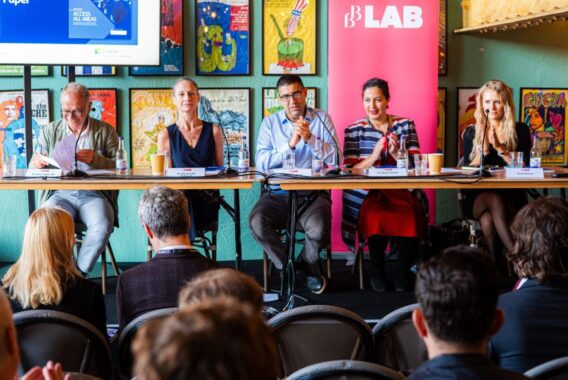


GP leaders, MPs and policymakers attended the launch of a major new white paper by Pulse and its publisher Cogora on access in general practice today.
The Access All Areas report was unveiled at a Labour Party conference fringe event in Liverpool hosted by Pulse and campaign group Rebuild General Practice.
In a session chaired by report author and Pulse editor-in-chief Jaimie Kaffash, attendees heard from a panel featuring Dr Simon Opher, Labour MP for Stroud and a practicing GP; Dr Samira Anane, portfolio GP, PCN clinical director in Manchester and BMA GPC England deputy chair; Dr Lisa Harrod-Rothwell, GP and Londonwide LMCs chief executive; and Rosie Beacon, head of health at public services think tank Re:State.
Panellists spoke about what constitutes access and differing interpretations among GPs, patients and the wider public.
The white paper is based on a survey of 2,000 general practice staff, interviews with more than 100, and an analysis of more that 25 data sets on each GP practice in England.
The white paper survey found almost half of GPs and practice managers see continuity of care as being a bigger priority than waiting times, ease of contacting the practice, offering face-to-face and on-the-day appointments.
Ms Beacon said: ‘I would probably challenge the notion that a patient should see who they believe they should see.
‘I obviously would have a preference to see a GP every time I had a clinical need, but no, but I don’t need to see a GP if I have a UTI – I just don’t.
‘That appointment could go to somebody who needs it much more than I do, and has much more complex needs, and actually does need to see an expert generalist.
‘The NHS doesn’t exist in a vacuum, and we can’t hire hundreds of thousands more GPs just because some patients have a desire to see a GP more than they do a nurse practitioner.
‘Unfortunately, it’s just not cost sustainable. It’s only going to get more expensive over the next 10 years as people get older and people have more long-term conditions, the majority of the burden of which will fall on GPs.’
Some panellists questioned if the vaunted increase in access for patients following the 1 October contract changes may have the opposite effect.
Dr Harrod-Rothwell said: ‘Demand will outstrip supply. The people who generally need our services the most are the people who find those online mechanisms the hardest to use. We’ll be talking about people who maybe have disabilities, who are maybe older.
‘You’re reducing the threshold of being able to access care, because rather than say, ‘is this worth hanging on the phone for’, we now can just press submit at three o’clock in the morning. But those who tend to need us the most can’t do that.’
In all, 41% of GP staff surveyed for the white paper said they would need to reduce their patient list size to provide the level of access they would ideally like.
Dr Anane spoke about the benefits and challenges of adopting technology to aid with access, and she elaborated on the reasons for the BMA’s new dispute with the Government.
The union has given health secretary Wes Streeting 48 hours to avoid a dispute over new online access requirements for GPs in England.
She said GP practices required ‘carrots’ and nudges to create the correct framework that enables people to default to the safest way of using the technology, rather than pressing a button overnight, which then creates a lot of danger.
‘Where our dispute with government lies is that we haven’t got that framework, and that is why patients will be at risk.
‘If you were going to bring out a drug, you wouldn’t just prescribe it, you would test it. Part of the issue is that we’re in a very finite and stressed environment, and we’re looking for silver bullets.
‘There are vested commercial interests that are driving some development, because they are testing their financial flows that aren’t coming into the NHS and necessarily benefiting patients directly. We need to be clear what the criteria and frameworks are that are designing and then implementing and deploying that.
‘We’re not Luddites in general practice – we are at the forefront of accepting and embracing innovation technology – but we want to do it safely.’
Ms Beacon talked up the role of AI in improving access, which was identified by the Government as one of ‘five big bets’ on technology which underpinned its 10-year plan.
She said: ‘There is a lot of evidence to suggest it can help a lot with AI-powered triage and filtering different types of appointments based on prioritisation.
‘I appreciate that as the complexity of the patient increases, it can become less helpful, but to say a young adult and I just needed some antibiotics or something, it’s perfect for something like that.
‘There is so much more going on in general practice (than in hospitals) that is purely about a human talking to another human, and you have to think of ways that AI can enhance that entire process.
‘So that’s ambient AI, transcription, AI to help with booking appointments, things that are kind of ordinary daily frictions.’
But she clarified it will not truly improve access in the NHS without higher-level, standardised adoption.
‘For the majority of the NHS, we still have a 1948 system in 2025. Adding AI on top of that sometimes doesn’t work.
‘You need to change the funding models. You often need to change the infrastructure. I think there is a slightly misguided view that if you just chuck AI a lot of problems in healthcare, it will fix them and it won’t’, she said.
Dr Anane reiterated that, as with all innovations adopted by the NHS, AI must be tested with patient safety in mind, and not replace the functions GPs themselves already effectively carry out.
‘As GPs, we are “therapeutic tools”. If we talk about continuity of care … someone comes in, I will remember that they’ve told me about something happened in their family or their social life, or their job, and then I can then contextualise that. We don’t have that with AI.’
The Access All Areas report calls for a complete reconfiguration of policy on general practice access.
You can find all the data and the methodology in the full report. Click here to download the full report. GPs can download it for free.
Commercial partner of this white paper: General Practice Solutions

Related Articles

READERS' COMMENTS [2]
Please note, only GPs are permitted to add comments to articles






This is the death nell for NHS General Practice as we know it. The most experienced person should be deciding who is the best person to see the patients not an algorithm or AI. So many mistakes are made by asking the wrong question at the start, which leads the patient down the wrong path. Example a patient I saw in A+E said she had chest pain so an ambulance was called because she answered the questions asked and her problem was she had fallen and bruised her chest, not having a heart attack. GP’s are the most cost effective members of the NHS team and had a gatekeeper role before the NHS was run like a business. Payment by results leads to gaming by hospitals to increase revenue. Now targets have to be met before patient care. I missed two phone calls trying to book a procedure and when I finally managed to speak to someone I had already been discharged back to my GP to refer me in to join the bottom of the list again. Patients are already voting with their feet by seeing GP’s privately if they can afford it. Another White Paper to reorganise the front door without addressing social care and community care will fail again.
As someone who was in the room during this panel discussion, I felt the need to have a further conversation with Ms Beacon about her understanding of GP skills and why they should be replaced by AI and allied health professionals. Unfortunately she showed no willing to understand the concept of a simple diagnosis being a retrospective diagnosis. She would not accept that the nuance of how a patient presents would be lost through AI algorithms. She did not understand how such ill thought through policies such as pharmacy first fragments care and causes some safety issues. Completely clothed eared but clearly is a strong influence on advising policy.