

Patients using AI to send legal letters to GP practices, says indemnity provider


Exclusive An indemnity provider has said it is seeing an increase in the number of patients using AI to write ’25-page long’ letters to GP practices threatening legal action.
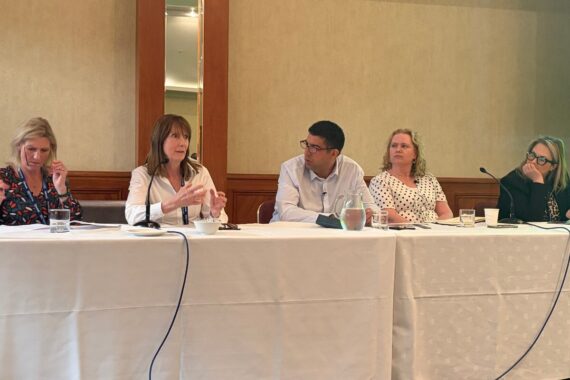
Speaking at the launch of a new white paper by Pulse and our publisher Cogora, Medical Protection deputy medical adviser Dr Sarah Townley told delegates at Pulse LIVE Birmingham that they are seeing a proliferation of complicated letters that contain legal arguments ‘that maybe don’t exist’.
The white paper, on complaints and the regulatory process, revealed that practices are seeing more patients using AI to generate complaint letters of seven pages and longer, which can be done in a matter of seconds.
However, at the panel discussion yesterday, Dr Townley said that this is not being limited to complaints, and Medical Protection is seeing this being used more for threats of legal action.
She said: ‘We’re seeing the use of AI in claims, we’re seeing it in litigation. People are bringing claims in their own name, they’re not using solicitors. These letters can be 25 pages long, quoting various legal arguments that maybe don’t even exist because it’s been generated by AI.’
Even if the claims have no legal merit, these are having major implications for practices, she said: ‘The workload being created by that is phenomenal, because you have to sift through so much more information.
‘It’s not about the severity of the complaint, that doesn’t equate to how long it is now. It can be something very simple, but then suddenly that’s now five or six pages long.’
This is also having the effect of lowering the thresholds around what patients will complain about, she said. However, she added: ‘I think most practices would much prefer to hear the patient in their own language, and then it’s much easier to decipher what the complaint is about and what the patient actually wants.
‘With AI, however, you get word soup that’s seven pages long, you then probably then have to spend more time reading it, and then probably having to contact the patient to say what actually is the complaint, what are you worried about, and go through all again. So you’re kind of doubling that workload.’
The Cogora report recommended a complaints IT system that would limit the words in the initial complaint in order to deter long, complex letters generated by AI.
Dr Katie Bramall, chair of the BMA’s GP Committee, said that this may be necessary to counter the use of AI. She told delegates: ‘Why can’t we as GPs put a [complaints form] on our website with a limited number of words, getting around a lot of the AI word soup and salad, which is much easier to now present.
‘I think there needs to be a nationalised, centralised, systematic addressing of complaints, where it is actually part of a bigger picture of the whole passage of care throughout the wider system. Patients can’t find out when their secondary care appointment is, and they can’t get through to people because the receptionists have gone at 4 o’clock and it’s a computer says no and switchboard says no mentality.’
The white paper focuses on the increase in complaints in the past few years, and its effect on GPs and practices, and discusses the use of AI.
Lee Bennett, strategic complaints lead at NHS England, who trains practices on the complaints processes, said his team is doing work on AI: ‘Some patients are using it to write letters and respond to letters from practices. This is proving quite a challenge across the NHS and other government bodies. It’s making some of the complaint letters overly complicated, confusing and in some cases inaccurate.’
As a response to this trend, the Parliamentary and Healthcare Ombudsman, has put a statement on its website suggesting useful prompts as a way of preventing overly complex letters.
RCGP president Professor Victoria Tzortziou Brown said: ‘Technology, including AI, may make it easier for patients to raise concerns and improve accessibility for some, but there is also a risk it could increase the number of complaints made in the heat of the moment or without full context.
‘Complaints processes still require careful human judgement, and it’s important concerns are considered fairly, proportionately and on an individual basis.’
It comes as a Pulse survey informing the white paper found 79% of GPs experience that the growing threat of complaints has led them to practise ‘defensive medicine’, potentially worsening patient care and access to general practice.
Pulse will be back in Birmingham next week for the Community Pharmacy and General Practice Conference, co-hosted by Cogora. GPs can sign up to attend for free here.
Related Articles

READERS' COMMENTS [8]
Please note, only GPs are permitted to add comments to articles







There’s a very simple answer. Use AI to generate the practice response.
GIGO.
Garbage In, Garbage Out
Continually failing, often remote working guideline and regulation severely addicted groups such as DHSC,NHS England and the destructive criticiser groups such as the CQC have masterminded an environment for the impending sharp decline of the NHS . The sheer demoralisation caused to NHS staff and patients could not be any more destructive and being championed by the CQC which delights in finding fault or encouraging others to denigrate but far removed from the actual purpose of whistleblowing in reference to safety. Hiding behind attacks and criticism of others, for a system they have ensured and evolved to focus on targeting and harassing those who actually work at the frontline yet those who avoid patient related risks cower behind the title of regulator or so called NHS leader . Most of us could revert easily to these criticiser positions but I am certain the opposite would not apply. Contrastingly speaking to a family member now working overseas today, the picture of collaboration, support and a unified co-operative workforce and management approaches being experienced in some other countries could not be more stark to the hostile environment which exists within the UK.
Also will our NHS be increasing the use of AI in all kinds of ways, including directing you away from A and E until you’ve used your i-pad to go online and somehow fill out an AI triage application? What? It might be quicker to apply for a job in Australia or go to A and E in Australia, USA, India or Canada, You bet. What is the relationship to Palantir IT to Keir Starman MP,dubious Mandelson and Streeting, former Health Sec, recently resigned? Can the future of Humanity and Britain really be this bleak? Can you blame patients with a complaint for joining in the race to use AI, when the NHS itself appears to be leading the race?
Whats happening to us is evidence of wider societal isssues facing the UK. It’s not just us being picked on. But also the Police, Teachers etc. Why work in the public sector when you could become an influencer.
Maybe GPs could be supported to sue patients who waste practice time with spurious complaints for moral injury and reputational harm….
I was doing a community dermatology clinic for an agency and received one of these. It was nearly 4 sides of A4 and e mailed 2 hours after the consultation. I honestly didn’t read after the second page. Interestingly the first paragraph said I’d not bothered to take any history but a little later said I took ages discussing before examining. Initially I was somewhat shocked until one of the admin team looked over my shoulder and said, get them all the time. When they turn up we know they are nonsense. Relax!
As an ageing GP starting in the 80’s the single most destructive (moral, cost, time, increasing patient anger etc etc) system is the complaints system. Never helped anyone and never helps the patient.
Indeed those clinicians that receive the most are the ones that don’t care.
I received one of these 4 pages long after 2 hours. I was stunned initially until one of the receptionists said, oh don’t worry they are common and we know if they are AI generated they are therefore nonsense otherwise someone would write a proper complaint!
Im an ageing GP. Over the 40 + years the complaints systems in their various forms have been the single most damaging system in GP land. Moral, time wasted which could be better used, defensive medicine, cost, recruitment! Etc!