

Government offers to quadruple specialty training posts to halt BMA strike action
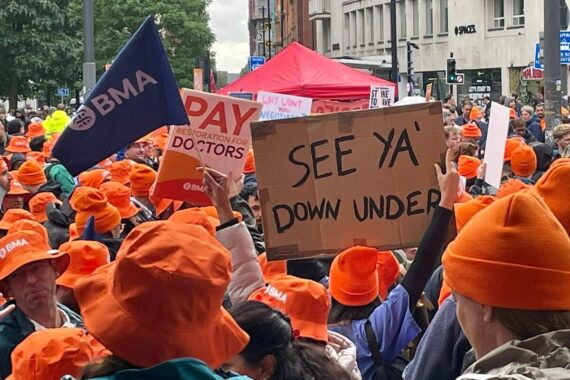


The BMA resident doctors’ committee (RDC) has said the Government has offered to create four times as many specialty training posts as it originally proposed in the NHS 10 year health plan.
The plan would see the Government create 4,000, rather than 1,000, training posts over the next three years – with the extra positions ‘repurposed from ‘locally employed’ roles already present in the health service’, according to the union. The ‘first 1,000 of those training posts’ would be brought forward to start in 2026, it added.
It also proposed pushing through ‘emergency legislation’ early next year that would ‘prioritise UK medical graduates’ for these specialty training roles.
The proposal comes as part of ‘an offer on ending the jobs crisis’ made by the Government to the union in an effort to curb strike action planned for later this month.
The RDC said the Government offered: ‘The increase of specialty training posts over the next three years from the 1,000 announced in the 10 Year Health Plan, to 4,000. These posts will be repurposed from ‘locally employed’ roles already present in the health service.’
As well as this, the offer includes:
- Bringing forward 1,000 of the extra training posts to start in 2026;
- Emergency legislation ‘in the New Year’ to prioritise UK medical graduates and other doctors with significant experience working in the NHS for specialty training roles;
- Funding mandatory Royal College examination and membership fees for resident doctors.
The BMA said it will consult resident doctor members in England on whether this is sufficient to call off the next period of strikes, scheduled to run from 17 to 22 December. It said it would do so through an online survey for members, closing on Monday 15 December.
If members indicate it is enough to call off these strikes, a formal referendum of resident doctors would follow, giving members time to consider the details of the offer and whether to accept it and end the current dispute.
While it is not known how many of the extra places would be designated for GP posts, statistics released in September revealed competition for GP specialty training posts has reached a record high, with roughly five doctors vying for each available place.
BMA RDC chair Dr Jack Fletcher said: ‘This offer is the result of thousands of resident doctors showing that they are prepared to stand up for their profession and its future. It should not have taken strike action, but make no mistake: it was strike action that got us this far.
‘We have forced the Government to recognise the scale of the problems and to respond with measures on training numbers and prioritisation. However, this offer does not increase the overall number of doctors working in England and does nothing to restore pay for doctors, which remains well within the Government’s power to do.
‘After their strike action succeeded in moving the Government from offering 1,000 training jobs to 4,000, as well as a plan on prioritisation for UK graduates and those who have worked in the NHS for some time, as a member-led organisation we are giving resident doctors their say.
‘If members believe this is enough to call off strike action then we will hold a referendum to end the dispute. But if they give us a clear message that it is not, the Government will have to go further to end industrial action.’
Health secretary Wes Streeting said the Government was ‘working around the clock’ to prepare the emergency legislation on UK-trained graduates that would ‘halve the competition for jobs that resident doctors currently face’.
He also condemned the BMA’s leadership for ‘holding the spectre of strikes over the NHS next week’ despite him offering the BMA ‘the chance to reschedule strikes in January after the vote has taken place’.
Mr Streeting said: ‘I am astounded that the BMA’s leadership rejected this. It means their NHS colleagues will this week be cancelling Christmas plans to cover shifts, and patients will have their operations cancelled, as the NHS prepares for the worst.
‘I cannot understand the wilful casualness with which the BMA’s leadership have chosen to inflict this pain on patients, other staff and the NHS itself. It is one of the most shameful episodes in the long history of the BMA.
‘I am appealing directly to Resident doctors, who now have an opportunity to vote for more jobs, better career opportunities, more money in their pockets, and to end the strikes. I urge them to vote for this deal.’
Commenting on the pre-Christmas strikes when they first announced last week, NHS England chief executive Sir Jim Mackey had called them ‘reckless’, ‘calculated’, and a risk to patient safety.
Related Articles

READERS' COMMENTS [6]
Please note, only GPs are permitted to add comments to articles







I do hope that if they don’t accept this, they delay any strike action – they will haemorrhage any residual public support if they strike next week.
In the last 20 years of real terms pay attrition the post covid junior doctors are the only cohort of doctors to do anything substantial about it. Every other ‘action’ by other doctor groups at other times has been fruitless grumbling, and the juniors of 2016 were betrayed by seniors and government. Promises by HMG to act later on vague improvements turn out to amount to a slow sweet FA, as GPs have seen for years in this can kicking contract dispute.
The genuine disruption the juniors have caused at personal expense (they don’t get their pay for strike days, and they suffer the abuse of media and condescension of government and seniors), has been the ONLY thing shown to get anywhere close to a reasonable pay offer. These juniors know that, and are clearly smarter and braver than all other cohorts in their actions befitting the knowledge that HMG only understands force. HMG will themselves force T&Cs and perpetuate the real terms pay devaluation and play a PR war , and words in absence of action by juniors are pissing in the wind.
And don’t think that the consultants didn’t then get a directly consequential easier ride in their demands, being able to benefit from the demonstrated ability of doctors (the juniors) to disrupt.
And GPs, being over a barrel as contractors similarly benefit from the juniors striking where they cannot. A show of resolve that GPs have not found the means to get anywhere close to themselves.
We were all juniors once. It was sh*t then and its sh*t now. They have my full support while I see so many fail to acknowledge the stand of the juniors has done far more to force HMG than the rest of us.
Yesterday a poll showed that 85% public do not support a strike( I know ITV breakfast!). Labour and the public support the NHS, tories and faragists want to abandon it. Our problem is resident doctors and our BMA by their actions over last years seem to want to destroy it too. Now imagine ITV showing the family who have lost someone from flu meeting striking doctors in their Santa hats outside the hospital gates. Compromise and calmness needed.
We are losing our younger generation to Australia, the Middle East, the Americas. The public need to understand this. They will not have a health service in the UK. This will break the NHS and healthcare will become a private venture. We already have dental deserts. The current trajectory is that we will have the same in hospitals and General practice. Great news about wales and Scotland. We can do this in England. The residents need to be supported by us every step of the way.
Lots of unemployed Juniors.
Sack those who don’t want to work and replace with those that do?
They have a genuine grievance how they are treated by the NHS, and how rubbish the training is; but sympathy has been dissipated by striking, and in particular striking for more money. Are they really that clueless as to how well paid and privileged they are compared to many of their patients,?
The NHS has failed staff and pay; time to replace with something a little less rubbish; Australia and Taiwan would be good places to start looking for ideas for better systems.
The NHS has not failed- we are failing it by insisting doctors are the answer so prioritisiing our importance. Sorry to tell you (but it’s been true since 1948!) it’s education, reducing poverty and improving diet/ encouraging exercise that we must invest in plus supportive care for the many over 80’s ahead. We risk losing any remaining reputation by BMA’s actions over last few years- attacking colleagues who work only in the NHS and promoting privatisation as the answer when we know that means the poorer will suffer. Ask someone who has had cancer treatment who cannot afford any health insurance!