

Vaccine commissioning ‘should not encourage GPs and pharmacists to compete’
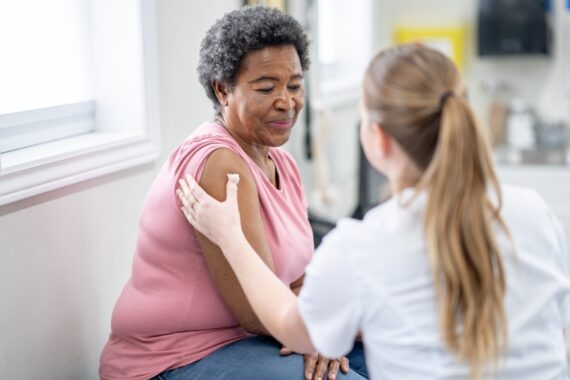


Pharmacies and GPs were ‘set up to compete’ for vaccination incentives when they should be encouraged to collaborate, primary care leaders have said.
Speaking at the Community Pharmacy and General Practice conference on 22 June, a panel of primary care experts criticised the way vaccinations are commissioned to reward individual practices or pharmacies instead of overall population health.
Dr Steve Taylor, GP and co-lead of the Doctors’ Association UK, said: ‘We were set up to compete with each other in way that isn’t right, and therein lies the problem.
‘If [vaccine commissioning] could be set up more collaboratively with no funding losses, everyone wins, and the most important people who win are the communities we serve.’
The panel agreed that the main priority should be connecting patients with healthcare, improving vaccine uptake and offering them a ‘seamless’ service.
Healthcare services manager for Asda, Richard Harrison, said: ‘If we strip out the money issue, we’re all healthcare professionals who want to do what’s right for the patient.
‘Everything should be about the patient, and we should be working more clearly together to do whatever we can to get vaccines in arms.’
This is especially salient given the gradual decline in vaccine uptake across the UK in recent years.
Recent NPA analysis found that flu vaccine uptake among children had dropped to 52% last year – and 8% decrease from the highs of 2018. In 15-16 year olds, it had fallen to a record low of 42%.
Mr Harrison explained that pharmacies can vaccinate patients who can’t get a GP appointment – for example, those who don’t have time to visit the GP during normal working hours.
Dr Taylor felt that clinicians across primary care should focus on vaccinating communities where uptake is low rather than competing for the same patients.
He said: ‘General practice is doing a very good job of getting most people in the door. The question is: how do we reach the others, and how do we do that together?’
Lucy Brotherton, deputy director of nursing and allied healthcare professionals at Symphony Healthcare Services, said she thinks outreach is the answer.
She said: ‘Outreach is really important. Some of the best vaccination models I’ve seen are where those services actually go to the patients: to the community centres, to our housebound patients, to our nursing homes.
‘We did really well with some of that during Covid, but I don’t know if we have taken any time to learn from what we achieved.’
She also stressed the importance of education and engagement for improving vaccination uptake.
‘Vaccination isn’t just about putting the needle in somebody’s arm. There is a whole process before we even get to that point – education, engagement, ensuring that we really get informed consent,’ she said. ‘We aren’t currently doing all that stuff to ensure the right message gets out there.’
Two measles deaths in children have been reported so far this year alongside 736 confirmed cases, the UK Health Security Agency (UKHSA) recently revealed.
As a result of case numbers in 2024 and the re-establishment of endemic transmission, the World Health Organization revoked the UK’s measles elimination status earlier this year.
And measles, mumps, rubella and varicella (MMR/V) vaccinations will be the focus of this year’s vaccination catch-up campaign, NHS England has said.
There have also been more ‘clusters’ of meningitis than normal this year including a deadly outbreak in Kent.
In response, a one-off meningitis B vaccination programme for thousands of young people will be delivered by community pharmacies from the end of July.
The inaugural Community Pharmacy and General Practice conference, organised by Pulse’s published Cogora and the National Pharmacy Association, took place in Birmingham 21-22 June.
A version of this article was first published by Pulse’s sister title The Pharmacist
Visit Pulse Reference for details on 140 symptoms, including easily searchable symptoms and categories, offering you a free platform to check symptoms and receive potential diagnoses during consultations.
Related Articles

READERS' COMMENTS [1]
Please note, only GPs are permitted to add comments to articles






I don’t mind the competition, but the pharmacist would also have to do home visits, care homes etc for the playing field to be level.