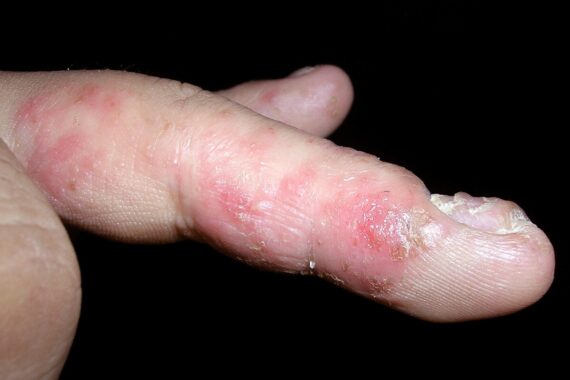
Fast Facts: Pompholyx (dyshidrotic eczema, cheiropompholyx) Definition / diagnostic criteria
Pompholyx is a recurrent eczematous disorder of the palms, sides of the fingers and sometimes the soles/toes, characterised by intensely pruritic deep-seated vesicles, sometimes progressing to bullae, followed by peeling, dryness and fissuring. Diagnosis is clinical, based on the typical site, recurrent course, vesicular morphology and exclusion of mimics such as tinea, contact allergy and palmoplantar pustulosis.
Epidemiology
It accounts for roughly 20% of all hand dermatitis cases. While it can affect any age, it is most common in patients under 40, with a reported mean age of 35. Around half of affected people have atopic eczema or a family history of atopy.
Diagnosis
Clinical features
Symptoms usually occur in flares lasting about 2–3 weeks. Patients often report prodromal burning or prickling, then very itchy 1–2 mm vesicles on the lateral fingers, palms and/or soles; vesicles may coalesce into larger blisters. After rupture or resolution, the skin becomes erythematous, dry, cracked, sore and sometimes bleeds. Chronic disease may show scaling, fissuring, crusting and occasional nail involvement. Bilateral, symmetrical disease supports pompholyx; unilateral dry/scaly disease should prompt consideration of dermatophyte infection.
Investigations
Investigations are usually unnecessary as the diagnosis is primarily clinical. Skin scrapings for mycology are advised when disease is unilateral, dry/scaly or there is nail involvement; pompholyx itself would usually have negative fungal microscopy/culture, whereas a positive result suggests tinea manuum/pedis. Patch testing is appropriate for troublesome, persistent or disproportionate hand eczema to identify allergic contact dermatitis; a positive relevant allergen supports a contact component rather than pure pompholyx. If lesions are weepy or crusted, bacterial swabs may grow secondary pathogens such as Staphylococcus aureus . Biopsy is rarely needed.
Differential diagnosis
Important differentials are:
Irritant or allergic contact dermatitis.
Hyperkeratotic hand eczema.
Tinea manuum/tinea pedis.
Id reaction secondary to dermatophyte infection (especially tinea pedis).
Palmoplantar pustulosis.
Psoriasis; hand, foot and mouth disease.
Bullous disorders.
Treatment
Management is extrapolated from hand eczema guidance and standard eczema therapeutics. Regular emollients are first-line and should be used liberally. Topical corticosteroids are used for flares; on palmar/plantar skin this commonly requires a potent preparation for a short course, with escalation or specialist referral if severe or refractory. Antihistamines are not recommended routinely, though a sedating antihistamine may occasionally help sleep-disturbing itch. Treat secondary infection when present. Severe and refractory cases will need referral to secondary care dermatology services.
Prognosis
Pompholyx is usually chronic-relapsing rather than curable. Flares come and go, often over years, but symptom control is achievable with trigger avoidance and appropriate topical therapy. Prognosis is worse when there is ongoing irritant exposure, occupational wet work, contact allergy, infection or severe chronic hand eczema causing fissuring and functional impairment.
Further reading
Primary Care Dermatology Society. Eczema: hand (and foot) eczema . Last updated July 2025
British Association of Dermatologists. Patient information leaflet: Hand dermatitis (hand eczema) . October 2023
DermNet NZ. Dyshidrotic eczema (pompholyx) . February 2023