

Deteriorating COPD – how to escalate treatment and move to palliative care
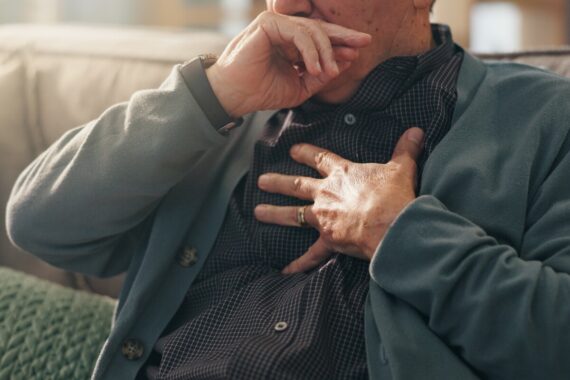


Clinical conundrum: GPSI in respiratory medicine Dr Andrew Powell discusses a patient with a 20-year history of COPD who is struggling with worsening symptoms and has had three recent exacerbations requiring admission, exploring the appropriate treatment options and how to initiate palliative care
An 84-year-old man requests a home visit to discuss his breathing. He has recently been discharged after his third admission in recent months with an exacerbation of COPD. He was diagnosed 20 years ago and finally managed to give up smoking three years ago, though he feels his symptoms have worsened since. He takes a LAMA/LABA/ICS combination inhaler, but doesn’t think this helps much, is getting fed up with his trips to the hospital and wants to know what more you can do to help him. His daughter points out that the oxygen they administer at hospital seems to help, and wonders if this could be given at home.
In a situation like this, what further treatment escalation can be offered? What other diagnoses, contributory factors and complications should the GP consider?
COPD exacerbations carry significant morbidity and mortality. The patient has stopped smoking, which is incredibly important. You would want to ensure that he has the annual ‘flu’ jab, has had the pneumococcal vaccine, the RSV vaccine and appropriate Covid vaccines. Check his inhaler usage and technique. If he can generate a good inspiratory flow (which can be assessed with an In-Check DIAL device), then a dry powder inhaler might be appropriate; otherwise, a metered-dose inhaler with a spacer is preferable.
Pulmonary rehabilitation should be a cornerstone of care for all patients with COPD, irrespective of severity, especially in those with functional limitation due to breathlessness (modified Medical Research Council Dyspnoea Scale (mMRC) grade 3 – ‘stop for breath after walking about 100 yards or after a few minutes on level ground’) or frequent exacerbations. It combines aerobic and resistance exercise with education and support, and significantly improves symptoms, exercise tolerance, confidence in self-management and reduces exacerbations (up to 40%). Programmes can be online or virtual and can include seated exercises.
Before considering further pharmacological treatment, it is important to consider the potential underlying pathophysiology.
Some patients with COPD have type 2 inflammation, which usually manifests as a raised (>300 cells/mm2 or >0.3×10⁹/L) eosinophil count in the peripheral blood, either when the patient is well or during exacerbations (note that oral steroids will suppress eosinophils). These patients can benefit from a low-dose inhaled corticosteroid (ICS) in addition to dual bronchodilation with a LABA and LAMA, given in a single inhaler (as prescribed to this patient), reducing exacerbations by about 20%. However, if the eosinophil count is persistently low (<100 cells/mm2 or <0.1×10⁹/L), there is no benefit from the ICS, and a small pneumonia risk.
Research indicates that triple therapy is inappropriately prescribed in a proportion of patients with COPD, for whom the risks of ICS therapy outweigh any benefit. If, for example, on his admissions, this patient was diagnosed with pneumonia and had an eosinophil count consistently below 0.10 x 10⁹/L it would be appropriate to stop the ICS (there is no need to taper).
However, if he has confirmed type 2 inflammation and continues to exacerbate despite triple therapy and non-pharmacological measures, then biologic therapy (both dupilumab and mepolizumab are approved by NICE) may be an option, as they have been shown to reduce exacerbations by about 20-30% in these patients. The treatment can be self-administered at home, so this may be worth discussing with the patient and the local respiratory team.
Azithromycin is another option for current non-smokers having four or more exacerbations a year with sputum production (or exacerbations requiring hospitalisation) and who are receiving optimal pharmacological and non-pharmacological therapy as outlined above. Upon advice from a respiratory specialist (after checking an ECG for a prolonged QTc interval, baseline LFTs, sputum for non-tuberculous mycobacteria and often a CT scan for bronchiectasis), it is usually given as 250-500mg three times a week on Mondays, Wednesdays and Fridays from October to April and can reduce exacerbations by about 35%.
Finally, lung volume reduction, either surgical or bronchoscopic, in highly selected patients (those with severe emphysema and significant hyperinflation) can significantly improve breathing mechanics, breathlessness and exercise tolerance. The patient needs an intensive work-up, and it’s an invasive procedure, so it may not appeal to them.
Always consider possible co-existing and co-morbid conditions. Heart failure, cor pulmonale, anxiety and obstructive sleep apnoea can all contribute to symptoms or be mistaken for exacerbations.
How should the question about oxygen be broached? When is it appropriate, and how should this be organised?
It is important to understand what benefit the patient felt they derived from oxygen in hospital, bearing in mind they were being treated for an exacerbation, and what symptoms the patient has when stable that they are hoping to improve.
Long-term oxygen therapy (used for >15hours/day) increases life expectancy in those with chronic, severe hypoxia. There is no consistent benefit in reducing exacerbations, hospitalisations or improving breathlessness. There is limited evidence that quality of life may improve, although this may be related to how the oxygen is delivered. For patients who only desaturate significantly on exertion, there is mixed evidence that supplemental oxygen may improve exercise tolerance; a trial of ambulatory oxygen can be considered and continued if there is improvement in exercise capacity. Conversely, there is some qualitative evidence that patients may feel ‘tethered’ to their oxygen supply, and it can interfere with activities of daily living.
Ideally, oxygen should be assessed and supplied through a specialist community team. Refer if the patient’s resting or exertional oxygen saturation is 92% or less – I usually measure first when they sit down after walking into my room and then later in the consultation. The patient needs to have been stable post-exacerbation for 8 weeks and will need a home assessment (for safety) and an assessment to guide selection of equipment, such as concentrators and cylinders. They must not smoke or vape. If there is no oxygen assessment service, then oxygen can be ordered on a Home Oxygen Order Form and sent to the regional oxygen supplier.
If breathlessness is troubling, then advise the patient on breathing exercises. Pursed-lip breathing – involving relaxing the shoulders, breathing in slowly through the nose for 2 seconds, then puckering the lips (like blowing out a candle) and breathing out slowly for 4-6 seconds – provides a little expiratory pressure and helps prevent dynamic hyperinflation. Fan therapy – directing a stream of cool air at the face via a handheld fan held about 6 inches away – can dampen the sensation of breathlessness and reduce anxiety. Mindfulness can also help.
Medication may have a role if breathlessness persists despite optimal disease management and non-pharmacological methods. It is important to distinguish between ambulatory and palliative populations. The recent MABEL trial showed that low-dose morphine (5-10 mg slow-release morphine twice daily) did not improve breathlessness in a non-palliative COPD population, although it did slightly increase exercise tolerance and decrease cough, at the expense of expected opiate-related side effects. Opiates can be helpful in end-of-life care and should always be prescribed with laxatives. Low-dose lorazepam (0.5mg up to twice daily either orally or sublingually) can help, particularly if there is an overlapping anxiety component.
How can the GP recognise when the patient is reaching end stage COPD and requires palliative care? What aspects of this should the GP discuss and what treatments are particularly helpful to relieve the distress of this situation?
It is important to understand that palliative care is not synonymous with end-of-life care. Shifting the focus from disease management to symptom management is a spectrum, and one does not preclude the other. In patients such as this, with severe disease, troubling daily symptoms and frequent exacerbations, early palliative care involvement is essential (although it can be difficult to access). This is the ideal time to plan, with the patient and his family, what his future care should look like. Three pillars can be considered – advanced care planning, symptom palliation and support for caregivers.
Assuming the patient has mental capacity, it is worth considering an Advanced Directive, which outlines which treatments they would like to refuse in the event of losing mental capacity, and (a person can hold both) a Lasting Power of Attorney, which appoints someone else to make health and welfare decisions on their behalf if you lack capacity.
A care plan should include the patient’s wishes regarding exacerbation management, such as admission to hospital and non-invasive ventilation, and their preferred place of care and death and resuscitation, along with a general discussion regarding disease trajectory, symptom management and an assessment of the patient’s psychological and spiritual needs. This should be documented and recorded in the medical record and shared appropriately with local NHS services (such as out-of-hours).
It is helpful to plan for ongoing care needs as well as for emergencies. Organisations such as the Princess Royal Trust and the Carers Trust are invaluable and offer vital support to carers.
Sources
- Ariel A et al. Rational use of inhaled corticosteroids for the treatment of COPD: a plain language summary. J Comp Eff Res 2023 Dec;12(12):e230136
- BNF. Treatment summaries: Oxygen.
- Choi J et al. Pulmonary Rehabilitation Is Associated With Decreased Exacerbation and Mortality in Patients With COPD: A Nationwide Korean Study. Chest 2024;165(2):313-22
- Johnson M et al. Morphine for chronic breathlessness (MABEL) in the UK: a multi-site, parallel-group, dose titration, double-blind, randomised, placebo-controlled trial. Lancet Respir Med 2025;13(11):967-77
- NICE. Chronic obstructive pulmonary disease in over 16s: diagnosis and management. Recommendations: Managing stable COPD. [NG115] 2019
- O Suen A et al. A Person-Centered Approach to Supplemental Oxygen Therapy in the Outpatient Setting. JAMA Intern Med 2025;185(6):720-733
Pascoe A et al. A narrative review of proactive palliative care models for people with COPD. Ther Adv Respir Dis 2025;19:1-17
Useful resources
- Princess Royal Trust – https://carercentre.com/
- Carers Test – https://carers.org/
- Asthma and Lung UK. Breathing exercises video – https://www.asthmaandlung.org.uk/living-with/keeping-active/keep-active-programme/managing-breathlessness
Visit Pulse Reference for details on 140 symptoms, including easily searchable symptoms and categories, offering you a free platform to check symptoms and receive potential diagnoses during consultations.







