

Children’s online safety should be treated as public health issue, says RCGP
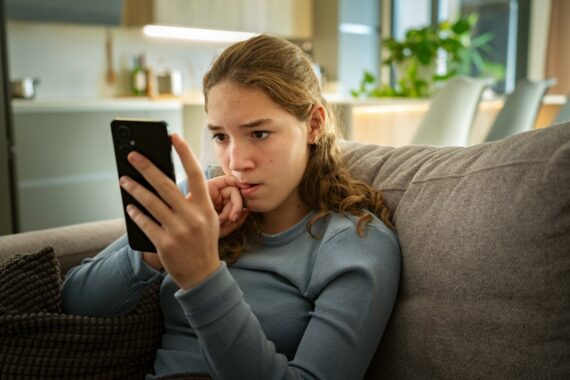


The harmful effects of children being exposed to violent or sexual content online should be treated as a public health issue, the RCGP has said.
In a position statement, the college said that GPs ‘increasingly’ encounter digital exposure in children as a contributory factor in mental health issues – including anxiety, low mood, self-harm, disordered eating, sleep disturbance and attention difficulties – as well as school avoidance.
It comes as the Government launched a consultation on children’s social media use and phone bans in schools ‘to protect young people’s wellbeing and ensure safer online experiences’.
The RCGP called for specific training for GPs and primary care on digital harms, as well as clinical tools and time to tackle the issue effectively within consultations, and for digital harms to be considered ‘routinely’ in health assessments.
But it stressed that responsibility for protecting children’s wellbeing must sit with policymakers, regulators and technology companies as a public health issue, not solely with families or clinicians.
Amid concerns that young people’s lives are dominated by too much time in front of devices, the Government said it will support families by producing ‘evidence-based screen time guidance’ for parents of children aged 5 to 16.
Announcing the consultation yesterday, the Government said that ‘immediate action’ will include Ofsted checking school mobile phone policy on every inspection, with schools expected to be ‘phone-free’.
The RCGP warned that whatever safeguards families put in place to keep children safe online, once a young person has access to a smartphone, parental controls ‘can only ever go so far’.
RCGP chair Professor Victoria Tzortziou Brown said at the extreme end, easy access to harmful online content can have ‘serious, even fatal, consequences’.
She said: ‘Advice promoting suicide or self-harm, the glorification of extreme sexual practices, and reports of unhealthy emotional relationships with chatbots rightly attract concern.
‘The relentless nature of social media and its impact on mental health are also well-documented.
‘But beyond these headline-grabbing examples lies a quieter, more pervasive risk: health misinformation and disinformation.
‘The RCGP recognises digital harm, in its various forms, as a modern determinant of health. Addressing this, particularly with regard to children, and protecting trust in health information should be treated as a public health priority.’
RCGP position on digital harms and children
RCGP supports a preventative, child-centred approach to digital harms, grounded in the following principles:
- Early recognition and prevention – Digital harms should be considered routinely in health assessments, safeguarding work and mental health presentations, with age-appropriate enquiry and guidance.
- Support for parents and carers – Families need consistent, evidence-informed advice that acknowledges the challenges of modern parenting rather than assigning blame.
- Professional education and guidance – GPs and primary care teams require training, clinical tools and time to address digital harms effectively within consultations.
- System-level responsibility – The responsibility for protecting children’s wellbeing must sit with policymakers, regulators and technology companies, not solely with families or clinicians.
- Equity and inclusion – Responses to digital harms must recognise and mitigate their disproportionate impact on children facing poverty, neurodiversity, disability or social adversity.
Source: RCGP
The Government’s consultation on children’s use of technology will seek views from parents, young people and civil society and ministers will respond to the consultation in the summer.
Evidence from around the world will be examined on a range of suggested proposals, including looking at whether a social media ban for children would be effective and if one was introduced how best to make it work, the Government said.
The consultation will look at options including raising the digital age of consent, implementing phone curfews to avoid excessive use, and restricting potentially addictive design features such as ‘streaks’ and ‘infinite scrolling’.
It will seek views on a range of measures, including:
- determining the right minimum age for children to access social media, including exploring a ban for children under a certain age
- exploring ways to improve the accuracy of age assurance for children to support the enforcement of minimum age limits
- exploring further interventions to support parents in helping their children navigate the digital landscape, for example further guidance or simpler parental controls
Professor Tzortziou Brown also said that GPs are seeing more patients who have received ‘inaccurate, confusing or potentially harmful advice’ from AI tools in response to health concerns.
These systems can produce confident answers that sound ‘medically authoritative’, but often are not and this can lead to missed diagnoses, ‘unsafe’ self-treatment or ‘dangerous’ delays in seeking help.
She added: ‘Algorithms repeatedly expose people to similar content, reinforcing messages whether they are accurate or not. When misleading health information is amplified in this way, the consequences can be genuinely dangerous. This challenge is being intensified by the rapid growth of artificial intelligence.
‘Technology has already achieved extraordinary things, and its potential in healthcare is immense. We should embrace innovation, but we must do so safely and responsibly.
‘That means clearer standards for online health information, stronger expectations on platforms to prioritise reliable sources, and better public understanding of the limits of AI-generated advice.’
Last year, the RCGP was among 14 health and social care organisations who joined forces to call on the Government to outlaw physical punishment of children.
Visit Pulse Reference for details on 140 symptoms, including easily searchable symptoms and categories, offering you a free platform to check symptoms and receive potential diagnoses during consultations.
Related Articles

READERS' COMMENTS [2]
Please note, only GPs are permitted to add comments to articles







If it is OK for Tom and Jerry; Wiley Coyote and the Road Runner; Wyatt Earp; and even Benjamin Netanyahu and the Orange Criminal president of a small backward country between Canada and Mexico in Real Life, versus the countries they have invaded or threatened, how can it be LESS appropriate for children to watch online?
Perhaps what we really need to rethink is our attitudes to bullying and violence in Real Life and examples set by powerful so-called world leaders and national celebrities and politicians first?
And, rather violent in itself maybe, but perhaps a return to ‘fire and brimstone’ sermons from the Church’s great orators too!
Agree there is a soul-less emptiness in our national political debate, occupied by immoral politics and the leeches of media/lobby groupies/”thinktanks” etc, all motivated by simple acquisitory greed.
I’d welcome church (and other faiths) leaders getting stuck into the debate about our country’s hard-won values, morals and direction, rather than leaving it to the likes of so-called “Christian” Tommy “Underpants” Lennon..