

‘Nationwide network’ of walk-in GP services announced
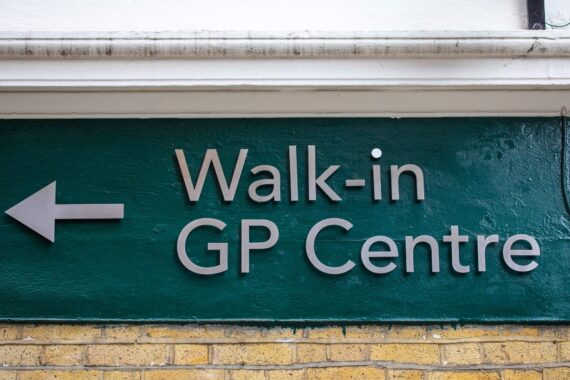


A new ‘nationwide network’ of walk-in GP services will deliver one million extra appointments in Scotland, its government has announced.
Speaking at the SNP’s annual conference yesterday (13 October), First Minister John Swinney said the Government would pilot the scheme with fifteen sites across Scotland, with the first opening ‘within the year’.
Mr Swinney said the accessibility of the centres would be a ‘break from the status quo’ and would be open from noon to 8pm, seven days a week.
He said: ‘The SNP government will open a nationwide network of walk in GP services based in your community, on your local high street, near your child’s school or close to your workplace, they will break from the status quo.
‘They will add to the care we already value, staffed by GPs and nurses, open from 12 noon to 8pm, and you won’t need to call up for an appointment.
‘That means more people can go after work when it fits with their lives. To make that even easier, they’ll be open seven days a week.
‘We will expand this network, but it will begin with fifteen sites across Scotland. They will deliver over one million additional GP and nurse appointments, and the first will be up and running within the year.’
Health secretary Neil Gray – who is set to address the Pulse LIVE Glasgow conference next week – said the services would be ‘designed in collaboration with NHS Boards, GPs and other partners to ensure they strengthen existing services’.
Commenting on the announcement, RCGP Scotland chair Dr Chris Provan said the proposals sidestepped issues around workforce shortages and even risked ‘driving down the quality of care’.
He also questioned the practicalities of the proposals, around staffing, continuity of care and capital investment in new premises.
Dr Provan said: ‘Promises to improve patient access must be practically meaningful and not just create a more fragmented service.
‘We want to be able to provide our patients with quality access to their GP but emphasis on speed can simply risk driving down the quality of care for patients.
‘Our concern is that this proposal does not address the major barriers to good access: critical workforce shortages and unmanageable workload. While there has been a modest increase in whole-time equivalent GPs over the past year, Scotland still has fewer GPs today than it did a decade ago. This is the fundamental problem.
‘Who will staff these new services and their extended, weekend hours? How will continuity of care be preserved, when patients benefit enormously from knowing and trusting their regular GP? Where will these services be located, when many GP practice premises are not fit for purpose and are waiting for long overdue capital investment?
‘The best way to deliver improved patient access and care would be to provide the level of investment needed to overcome the impact of cumulative years of underfunding and the implementation of a long term workforce strategy to increase the number of GPs.’
The college’s own 2026 Scottish Parliament election manifesto argued that general practice’s share of NHS funding should be restored to 11%.
To achieve this, it said the next Scottish Government should commit to a substantial increase in the amount of general practice expenditure in each year of the next parliamentary term.
In August, an extra £15m investment for GP practices as part of the 2025/26 contract was announced, with GP leaders warning it will not reverse issues of underinvestment in general practice and GP unemployment.
And workforce survey data has revealed the number of whole-time-equivalent (WTE) GPs in Scotland increased this year for the first time since 2019 – 3,591 WTE, up from 3,453.1 (a 4% increase).
Related Articles

READERS' COMMENTS [4]
Please note, only GPs are permitted to add comments to articles







In England WiCs / UTCs started in 2000. Have they made GP services more accessible since then? Surely in 2025 people are expecting to log in and see wait times / book a ticket not walk in and queue as they did 100 years ago. Are these 15 WiCs going to take all the £15m “extra” for GPs in Scotland?
This is how you throw loads of money at ‘primary care’, or even ‘general practice’, whilst at the same time reducing funding to General Practices/Surgeries, hence reducing the service level that GP Surgeries can provide, and harming patinets, in favour of certain limited groups of able-bodied walking patients. I really doubt that it can be ‘nationwide’ too, guven that this implies evrybody will be able to walk into one, even those resident on small islands. And isn’t it a bit discriminatory against those who cannot walk? Established GP services should be built up instead, Scotland and here.
Will they be able to do blood tests and follow ups? Be able to refer? I suspect the burden of this work will fall to the actual Gp / Gp to please do this ….
If only there was a well established service crying out for extra funding to employ more clinicians that would be able to use this money if a more efficient and Scotland wide manner