

Dr Katie Bramall: GPs are stronger collectively than individually
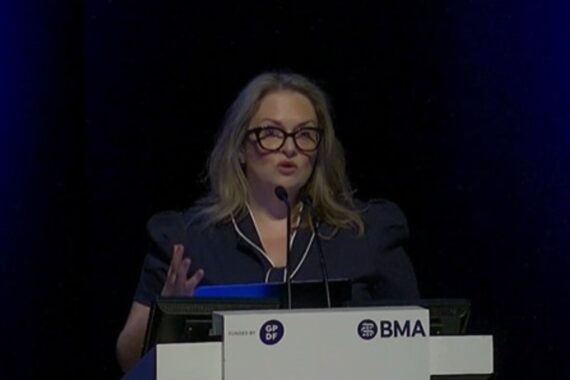


BMA GP Committee chair Dr Katie Bramall opened the UK LMC conference in Belfast today with a speech about professional unity
Conference, colleagues, friends – good afternoon and welcome to Belfast. The last time we held LMC Conference here was in 2019. I was in Alistair’s seat and was reeling from having just had strips torn off me from a very well established male LMC chief executive who was later removed from his LMC. That ended with the inquiry and review led by Daphne Romney KC.
We still have problems, only now, as is the case with the wider political and societal arena, these are often being played out for hundreds to see. That can be baseless accusations on WhatsApp groups, pile-ons on list servers and mistruths peddled as exclusive leaks to the pages of Pulse or GP Online. We need to take care to ensure that in our enthusiasm to tell our truths, we don’t inadvertently hasten the demise of the very thing we are meant to be fighting to protect.
Though perhaps I should be careful.
Some days it can increasingly feel like I am the Keir Starmer of GPC England. And yes, absolutely there are people who would celebrate my departure. But whenever it is asked – well what would you do? What policy ideas do you have? – the room suddenly becomes extraordinarily quiet.
There’s a lesson there somewhere. Politics can offer perspective. Because if there is one institution currently more internally stressed than the Parliamentary Labour Party, it’s the NHS.
And before anyone asks – yes, I absolutely did leave writing this speech until the very last minute. Partly it’s the florid unmedicated ADHD, partly because I’m a GP, and therefore psychologically incapable of starting anything before it becomes a genuine emergency. But mostly because every time I sat down to start to think about what I would write over the last week, I turned on the news and discovered another fresh instalment in what now appears to be the season finale in the Westminster production of the ‘Labour Party Leadership Crisis’.
When I was reading the news this morning, I genuinely thought it would be irresponsible to finish this speech too soon, because the headline of the sacking of Wes Streeting felt a dead cert. There seemed a perfectly realistic possibility that by now Wes Streeting would no longer even be health secretary. Or chancellor. Or Prime Minister. Or in fact still technically inside the Labour Party.
There’s no point spending time crafting thoughtful remarks about ‘working constructively with Wes Streeting’ only to discover he has been reassigned to delivering the Northern Powerhouse and sent on a listening exercise to Doncaster. Big up Doncaster LMC
It’s impossible to keep up. Every morning there’s another anonymous briefing. Another reshuffle rumour. Another ‘senior source close to the Prime Minister’ insisting everything is absolutely fine. Which, as GPs, we all know is a classic pathognomonic indicator of immediate clinical collapse.
The current Government operation feels remarkably similar to trying to review a discharge summary written at 5:47pm on a Friday afternoon. Nobody knows who changed what. Nobody knows whose responsibility anything is. And somewhere in the middle of it all somebody has written ‘GP to kindly resolve’.
And yet despite everything – the political chaos, the endless reorganisations, the policy churn, the slogans, the announcements, the ‘transformational moments’ unveiled every six weeks by ministers standing in front of badly positioned NHS-branded lecterns – general practice continues doing what it has always done. Showing up. Quietly. Reliably. Professionally. Holding our communities together while the rest of the system increasingly resembles a farce.
And we know the pressures. Unlimited demand. Workforce shortages. Retention crises. Public frustration. Administrative overload. The constant assumption that general practice can and will absorb more work indefinitely because – historically – we always have.
The NHS has developed an extraordinary dependence on GPs. Waiting lists rise? GP to kindly manage. Mental health services overwhelmed? GP to kindly support. Social care unavailable? GP to kindly coordinate. Hospital follow-up delayed for 14 months? GP to kindly sort out.
Those three words – ‘GP to kindly’ – may now be the single greatest cause of hypertension within British medicine. I sometimes think if archaeologists excavate the NHS in 500 years’ time they will uncover two things. First, a functioning fax machine. And second, an ancient Rosetta-like ceremonial stone tablet containing the sacred inscription: ‘GP to kindly deal with absolutely everything.’
But beneath the sarcasm and humour – and let’s be honest, sarcasm and humour is often the only coping mechanism available to us once we’re maxed out on Duloxetine Bisoprolol and HRT – there is something much more serious that I want to speak about today. Because this week has reminded me very sharply what really matters.
Many of you might know that sadly Tom Dolphin, chair of BMA Council, is unable to be with us this week following a sudden bereavement. A bereavement that has shattered those of us who are very close to Tom. I spent the weekend with him and I’ll be with him when I get back too. He is dominating my thoughts today, and his wellbeing will be my primary focus this week, so I apologise if I am not my normal self. I want to say publicly, on behalf of all of us gathered here, that we are holding Tom closely in our hearts right now.
Loss has a way of cutting through noise. It interrupts the endless churn of meetings and politics and headlines. It silences trivial arguments and WhatsApp traffic. It rearranges priorities in an instant. And this loss has made me think very hard about life. About how fragile it is. About how quickly lives and circumstances change in a single moment. About how all the things we spend so much time arguing over – committee structures, political manoeuvring, social media rows, media narratives, procedural disputes – can suddenly feel very small indeed.
And it has made me reflect deeply on why we are actually here today in Belfast. Why LMCs matter. Why representative structures matter. Why community matters. As an LMC secretary, my response to the most important part of my job is easy, predictable and consistent. It’s the pastoral support we deliver, that can change another GP’s life. Ultimately, I think the answer is simple as to why we are here today. We are here to support our fellow humans, in our professional roles and in our lives beyond general practice.
Because medicine can sometimes train us into believing resilience means carrying everything alone. That professionalism means never wobbling. That leadership means never admitting difficulty. But actually, some of the most important moments in medicine happen when people simply show up for one another. Not with strategic frameworks. Not with performance metrics. Not with task-and-finish groups. Not with PowerPoint slides containing arrows pointing in vaguely optimistic directions.
It is about presence. Kindness. Humanity. And we need more of that.
A quote someone shared with me this morning said: ‘You should always be rooting for the people you know. Not only because you may need their support tomorrow, but also because it feels good to celebrate something. Celebration can rescue your day – even if it is someone else’s victory. Envy will ruin your day – even if you think you’re actually winning.’
I wish there was a little more of that sentiment shared across our work right now. We spend enormous amounts of time in medicine criticising ourselves. Comparing. Competing. Second-guessing. Fragmenting. But we do not always celebrate each other enough.
And actually, there is much to celebrate. The professional unity we have built. The relationships we have built. How much we learn from one another. How much stronger we are collectively than individually. And that will matter a lot over the next few days, because there are motions on the agenda which, intentionally or otherwise, risk separating that unity.
And I would simply urge colleagues to think very carefully about the implications. Sometimes ideas can sound appealingly simple. A plan B always sounds simpler when written on a conference motion than when implemented in the real world.
The reality is far more complicated. That is why it matters that we actively listen. That we listen to colleagues from Northern Ireland’s Southern LMC, that we listen to Matt O’Foilin from the Republic of Ireland. Listen carefully to what he says – you may be surprised. Healthcare systems are extraordinarily good at making simplistic solutions look attractive right up until the point that we have to live, work and operate inside them.
Unity matters. Not because everyone agrees. No collection of doctors has ever entirely agreed about anything. If you put six GPs in a room together, you will get a dozen opinions, 50 WhatsApps, two motions and one strongly worded outraged highlighted in red ink 5000-word email.
Disagreement is not weakness. The question is whether we continue disagreeing with generosity, with respect, with the understanding that most people in this room ultimately want the same thing: A sustainable profession. Safe patient care. A future thriving for partnership-led general practice.
Another area where we are united is in our relationship with our patients. And that relationship is rooted in trust. Trust in continuity. Trust in confidentiality. Trust that the consulting room remains a protected space between the GP and their patient.
And that brings me to something critically important. Three years ago at this same conference, when I was sat in Matt’s chair, Chris Morris stood on this stage and warned about what happens if Government increasingly inserts itself into the consultation room. He warned about the consequences if patients begin to feel that the state is effectively sitting on the examination couch taking notes whenever something politically or commercially useful might emerge.
Three years on and those warnings now look extraordinarily prescient. Because today – literally today – the King’s Speech announces primary legislation in the form of a new Health Bill. Much of what sits behind that agenda concerns data. Patient data. GP patient data.
The extraordinary longitudinal record held within general practice. This morning the Financial Times has published an interview with me discussing precisely these concerns. The issue here is not about technological progress, nor opposition to research or innovation. General practice contributes enormously to medical research and the advancement of public health.
The issue is trust. Consent. Transparency. It is understanding precisely who has access to patient information, for what purpose, under what safeguards, and with what accountability.
That is why GPC England has initiated collective action around data sharing agreements. Practices are not being asked to manually switch off data sharing agreements – yet. They are not facilitating GP patient data opt-outs – yet.
They are not being asked to breach contractual obligations. They are not being asked to place patient safety at risk. They are just being asked to send a template letter that is lawful, proportionate, and safe.
Its purpose is straightforward. To ensure practices understand exactly which voluntary data sharing agreements they are signed up to. To establish where their patient data is flowing. To identify whether appropriate governance and DPIAs exist. To flush out ICB FDP plans, to reveal how the NHS has failed to appropriately cater for GPDOOs, to put them on notice (because that’s where we are going next) and to remind systems that GP partners remain the data controllers for the GP record.
This matters enormously. Scotland, Northern Ireland, Wales – if you believe you’re off the hook, and that this issue is somehow purely anglocentric, I’m afraid not. ‘Womp womp’ as my 11 year old would say. Ask the Department of Health whether these ambitions are England-only.
HDRUK’s ambitions are UK-wide. The clue is in their name. HDRUK links directly into the Federated Data Platform through shared infrastructure and research architecture. It drives the development of federated analytics programmes. It helps establish standards around interoperability, access, governance, and data architecture. So to colleagues in our devolved nations: This is not a question of whether you will face these debates and challenges. It is when.
And the reason collective action matters is because it creates leverage. Single practices acting alone are vulnerable. Thousands acting together are powerful. We have around 6,250 practices. This is one action per practice. One letter. That is it.
And importantly, this action was chosen carefully. It was chosen deliberately and strategically. It’s very kind of the monarch to have timed his keynote speech at the same time as mine. Because we needed a starting action to gather the many. That reduces partner liabilities and risks. That strengthens GP-patient trust. That targets the core of government strategy. That is easily reversible. That leaves LMCs and practices more informed. That can be undertaken in every ICB. And feels safe enough even for highly risk-averse practices.
This action achieves those aims. And crucially, patients won’t notice it. That is the point. Patients are not the target. But they will be getting the message, and we will be launching a BMA patient information campaign following today’s King’s Speech. The target is the assumption increasingly embedded within policy-making that GP-held patient data is simply an endlessly accessible strategic resource available for system redesign whenever required.
The proposed ‘Neighbourhood Health Service’ in England, the broader left-shift of activity from acute settings into community settings – it cannot function without GP population health management data. General practice sits at the centre of that infrastructure. And that reality creates responsibility – but it also creates leverage. It means insisting upon transparency, governance, proportionality, and trust. Because once trust is gone in healthcare, rebuilding it is extraordinarily difficult. And patients must never feel uncertain about whether their most sensitive information remains confidential.
That is why confidentiality matters; it’s why professional autonomy – the GP partnership model – matters, and it’s why this debate matters.
At the same time, we also face another major challenge regarding professional autonomy and regulation. It is creeping up silently. I hoped it might be new business on the agenda but it’s doing too good a job at flying under the radar. That is the Government’s consultation on reforming the GMC legislative framework across all four nations.
Now, some elements of the proposals are welcome. A less adversarial fitness-to-practise process is sensible. Reducing unnecessary trauma for doctors undergoing investigation really matters. The implementation of the Leng Review recommendation to rename physician and anaesthesia associates as assistants is also important in reducing patient confusion. But there remain very serious concerns.
The BMA has been absolutely clear about those concerns. Because this consultation still represents, in many respects, a missed opportunity. Doctors continue to feel profound distrust towards the GMC, and that distrust did not emerge by accident. Many colleagues feel the regulator lacks proportionality and accountability. It lacks sufficient understanding of the lived reality of modern medical practice. Particularly within our pressure cooker environments.
The retention of the GMC’s right to appeal tribunal outcomes remains deeply controversial. The failure to establish a legal duty of care towards doctors undergoing investigation remains troubling. The absence of an independent authority capable of investigating complaints against the GMC itself remains a significant concern.
And many doctors remain profoundly uncomfortable with the continued blurring of professional boundaries through the regulation of both doctors and assistants within a single organisation.
Our position must be clear. The GMC should become once again a single-profession regulator for doctors. The Professional Standards Authority alone should hold powers to appeal tribunal outcomes. The GMC should owe doctors a statutory duty of care.
Doctors deserve a governing structure with meaningful professional representation. The titles and identities of doctors require legal protection to avoid patient confusion. Regulation works best when it commands confidence and confidence requires fairness. Transparency. And trust.
It always comes back to trust. Trust between doctors and patients, between the profession and regulators, between practices and systems. Trust between colleagues. Perhaps that is the thread connecting everything we are discussing today. Because we are living through a period where trust feels increasingly fragile.
Public discourse feels angrier. Politics feels more performative. Institutions are brittle. And increasingly people are looking for somewhere – anywhere – that still feels human. And despite all the pressures we face, general practice remains one of the few places where people still believe someone will genuinely listen. Patients still come to us with their fears, grief, loneliness, shame and uncertainty. And they do so because, despite everything, they still trust us. That trust is precious. we must defend it fiercely.
But we must also defend one another. Because the pressures on this profession are immense. Burnout. Moral injury. Financial insecurity. Under-employment. Workforce shortages. Political hostility. Unlimited liability. Relentless scrutiny.
And too often we are expected simply to absorb all of this silently. To continue functioning coping and smiling when we are exhausted, when we might be grieving or struggling ourselves. None of us are meant to carry this alone. And perhaps one positive thing emerging from recent years is that we are becoming slightly better at recognising that. Slightly better at checking in and at acknowledging vulnerability.
Tell your colleagues: ‘I’m glad you’re here.’ We need more of that. Colleagues, I am so glad that LMCs are still here.
Despite all the challenges we face -and they are significant – I remain optimistic about the future of this amazing profession. Not because circumstances are easy. Not because Government policy is consistently sensible – clearly that would be a medically indefensible claim.
But because you, the people in this room are extraordinarily capable. LMCs and our GPCs are extraordinarily capable. Throughout every period of NHS turbulence, representative structures have repeatedly demonstrated resilience, intelligence, pragmatism, and courage since 1911.
We have faced unprecedented challenges before. We will face more. But we are capable of meeting them.
In England, who knows – by tomorrow morning we may even have a brand new secretary of state. Anything is possible, maybe even rowing back on the imposed impossible and unsafe England 2026/27 contract.
And if not, we will escalate. We will continue demonstrating exactly what collective professional unity can achieve. Because unity is our strength. Not noise, theatrics and division.
But solidarity. Humanity and professionalism in that LMC shared belief that general practice remains worth defending.
So while Westminster continues spinning like a tumble dryer full of leadership LinkedIn platitudes, we will continue doing what general practice has always done. Caring. Representing. Advocating. Supporting. Showing up: for our patients; for our communities; and most of all for each other.
Thank you.
Have you got a view you want to share with Pulse?
We’re always open to first-hand pieces and opinions from GPs.
Email your piece for consideration to be published on our site.
Related Articles

READERS' COMMENTS [1]
Please note, only GPs are permitted to add comments to articles






Targeting control and protection of patient’s data is in keeping with the oath we take to safeguard them – a noble way to look at it. And there’s no downside in patient harm (as there might be in eg, striking). In fact, the data we input is also our IP and, if you use voice recognition AI, you’re literally generating learning datasets for Thiel and Mosley for free…I don’t trust Palantir saying it won’t utilise or be able to access it. For me, they’re the Serpent tempting us with the fruit of AI, awaiting our Fall.
I support the BMA in this. Apply heavy pressure on this IT/data chokepoint, thwarting the Govt’s plans for Tech Bros to have us enserfed in an NHS SaaS technofeudal future. Rally the troops, quickly up-titrate to a full data boycott and take out adverts on this daylight data robbery – for which we’re actually paying Palantir! And organise a weekend protest march against corporate AI serfdom…