CPD: Casebook – skin cancer and pre‑cancer


GPwER in dermatology Dr Anjali Pathak discusses four cases involving potentially malignant skin lesions and their appropriate management. Complete the full module on Pulse 365 today.
Learning objectives
After completing this module, GPs will be able to:
- Explain the malignant potential of actinic keratosis (AK) and Bowen’s disease and decide when treatment versus watchful waiting is appropriate.
- Select and counsel on first‑line treatments for AK and Bowen’s disease in primary care.
- Recognise red flag features of subungual melanoma and amelanotic melanoma and have an awareness of when to refer to dermatology urgently.
- Balance conservative and interventional options for basal cell carcinoma (BCC) in a very frail patient and identify the features that warrant urgent assessment.
- Describe how dermoscopy can be used in primary care, where it helps most, and how to access training and equipment.
Case 1. Elderly patient with variety of skin lesions
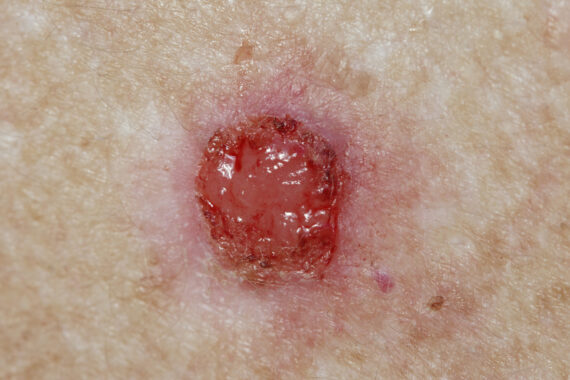
You see a 78-year-old male patient with a variety of skin lesions, all present for a year or more. One is a scaly plaque on his forearm, slowly increasing in size; the others are scaly, horny lesions on his scalp and forehead, which you suspect are actinic keratoses. You refer under your new local dermatology pathway, which involves photographs being sent to a dermatology triage clinic. You receive a letter back stating that the facial scalp lesions are actinic keratoses and the plaque on his arm is Bowen’s disease.
1. What is the malignant potential of actinic keratoses and Bowen’s disease, respectively? Do they always require treatment?
The risk of progression of individual actinic keratosis (AK) to invasive squamous cell carcinoma (SCC) is low and is commonly cited as <0.1% per lesion per year. However, patients often have field cancerisation, a large area of severely sun-damaged skin where multiple subtle changes coexist, increasing the patient’s overall cumulative SCC risk.1
AKs may remain stable, regress, recur or progress. If lesions are tender, hyperkeratotic, ulcerating, rapidly changing or in immunosuppressed or very sun-damaged patients, consider treating these. Thin, asymptomatic AKs can be observed with sun protection, emollients and self‑monitoring.
Bowen’s disease (SCC in situ) has a greater, approximately 3% risk of progression to invasive SCC over time.2,3 Most patients are treated rather than observed. Exceptions, such as significant frailty or patient preference, require clear safety‑netting.
2. What treatments can be offered for these lesions, and which are suitable for primary care?
Patients should be reminded of simple general measures: advise high-SPF, broad-spectrum sunscreen, hats and avoidance of sunbeds; use emollients, and debulk thick scale (e.g., with urea or salicylic acid preparations) before starting any field therapy.
Lesion-directed options, often suitable in general practice or community dermatology, include cryotherapy for isolated AKs and some cases of Bowen’s disease (using multiple freeze-thaw cycles or a longer single freeze for thicker lesions), and curettage and cautery for Bowen’s disease under local anaesthetic, commonly performed in community minor surgery settings.
Field therapies, which may be delivered in GP and community services or secondary care, include 5-fluorouracil (FU) 5% cream once or twice daily for approximately 3-4 weeks for AK according to to site, and longer courses for Bowen’s disease, according to local protocol.
Imiquimod 5% can be used with the licensed face and scalp AK regimen of three times per week for four weeks, followed by a four-week break and a repeat four-week course if needed; for superficial BCC the typical schedule is five times per week for six weeks; for Bowen’s disease, follow locally agreed off-label protocols.
Diclofenac 3% gel (Solaraze) for AK is usually applied twice daily for 60-90 days and tends to produce a milder inflammatory reaction. Photodynamic therapy (PDT) is another option for field AK and Bowen’s and is usually provided in secondary care.
Treatment options for AK and Bowen’s disease, and where treatment can be provided, are summarised in Table 1.
Table 1. AK and Bowen’s disease – treatment options in the community and secondary care
Lesion First‑line options Setting Thin AK Conservative Emollients Cryotherapy 5‑FU 5% Imiquimod 5% Diclofenac 3% GP/community Thick AK Debulk scale Cryotherapy Curettage 5‑FU Imiquimod PDT Community/secondary Bowen’s disease (SCC in situ) Curettage & cautery 5‑FU Imiquimod PDT Surgical excision Community/secondary
3. What are the potential side effects of these treatments and how should they be managed?
Field therapies used to treat areas of field cancerisation predictably cause erythema, erosions, crusting, burning, itch and post‑inflammatory dyspigmentation. Patients should be counselled about these risks and provided with written aftercare. You can consider short treatment breaks, bland emollients and simple analgesia, as well as a brief course of a low‑potency topical steroid (e.g., hydrocortisone 1% once daily for a few days) to settle severe inflammation.
Cryotherapy can cause blistering, pain, hypopigmentation or scarring so patients must be counselled and safety‑netted.
PDT is associated with procedure‑related pain and photosensitivity precautions; keep the area covered and avoid bright light for 24-48 hours.
Click here to complete the full module and log 2 CPD hours towards revalidation
Dr Anjali Pathak is a GPwER in dermatology and visiting lecturer in clinical dermatology at the University of Hertfordshire
Visit Pulse Reference for details on 140 symptoms, including easily searchable symptoms and categories, offering you a free platform to check symptoms and receive potential diagnoses during consultations.