

Dr Katie Bramall: ‘The Government is making us pay the price for the 2004 GP contract’
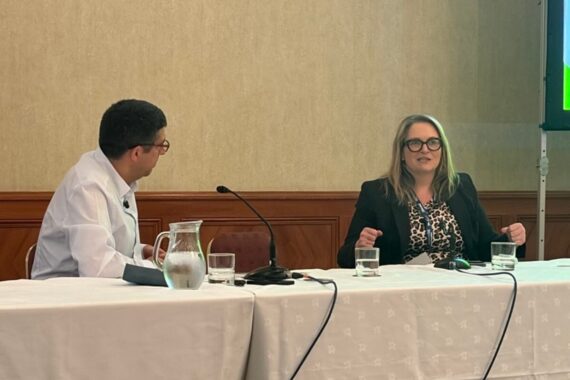


Pulse editor-in-chief Jaimie Kaffash hosted an on-stage interview with chair of the BMA’s GP committee in England Dr Katie Bramall at Pulse LIVE Birmingham on 10 June asking her what she wants from an overhauled GMS contract, about the next steps for collective action, and the future of the independent contractor model
Jaimie Kaffash: Working from a blank slate – what are the top three things that you want from an overhauled GMS contract which is supposed to be happening this parliament?
Dr Katie Bramall: Investment is the biggest thing. We said back in 2024 that really we need to be seeing a 15% floor of NHS total spend on general practice. At the moment it’s about 5% – if you add in PCNs and everything else, it’s about 10-11%. It’s nowhere near enough for what they want it to be.
[The Government] has spoken about left shift for so long, but I don’t think we quite appreciated that it wasn’t going to be resourced as well. Yes okay, shifting patient care makes total sense. But don’t give us your waiting lists at the same time.
We’re also bound by the Government cycle as well. The comprehensive spending review was pretty much a year ago today, and that’s the Treasury’s roadmap for how they’re going to fiscally endure the next three years.
They always leave a year before a general election for a bit of a pre-election splurge, where they hold back a bit of money and then spend it at the end, so they can point to nice things on an election trail. But that comprehensive spending review set rules around a limit of 2.8% for the NHS between now and the end of parliament, so for 2025/26, 2026/27 and 2027/28, your investment is locked, and trying to get anything more is going to be impossible.
So I’ve said to DHSC: ‘How does that square with the new contract?’ And they said: ‘Well, this was [former health secretary] Wes Streeting’s commitment, it wasn’t this Government’s commitment’. I think they’re still quite keen to move forward on substantive contract reform, but not in the way that we would want, and I can see it happening piecemeal.
So I’ve been trying to be really pragmatic – a bit like the suggestion to go from 8am to 4pm around online access. I think a lot of the guidance that will come out around exceptional pressures is going to be pragmatic and helpful. We have got skeleton staff at ICB level, so I think the risk of breach notices is going to be negligible, and I think they know that. Because they’ve got no staff to manage it, they’re not interested in breaching practices who are genuinely trying to do their best. If you’re taking the piss and you’re switching off at 8:05, that’s a different matter, but if you’re literally doing the best you can with what you’ve got, I think they’ll be supportive.
I set out a clear scoping document to Streeting back in March, and we did come back offering bilateral negotiations, but that was dependent on us not taking any collective action. But at the same time [there was] a refusal to engage in blocking advice and guidance, and a refusal to engage in the unlimited access.
So our three big big goals [for GMS overhaul] are around: Restoring the viability and attractiveness of partnerships and seeing them expand – not contract; providing fair remuneration for all GPs; and having workload safeguards that are going to keep patients and GPs and their practice teams safe.
Obviously the Government will have goals in mind. They’ll have parliamentary commitments they want to give, so we need to understand those and try and integrate them.
In terms of the scoping, my thinking was to have a 90-day pause where you jointly consult other stakeholders over July and August. In September, October, you commence negotiations proper, you put the contract to a vote in the second half of 2027 implementing from April 2028.
But you’ve got to agree some interim confidence building steps for all of your stakeholders, not least the profession. The key one would be the 2027/28 contract. So I would see it as a step one and step two change.
But the big barrier is the lack of money, and the biggest red flag to me is Carr-Hill reform. That was meant to come back with the National Institute for Health and Care Research (NIHR) in March, but there has been silence. My big worry is that we’re looking at a fixed funding envelope where you’re basically taking all the chairs on the deck of the Titanic, throwing it up in the air, and to see where they land.
Practices have been managing on established Carr-Hill formulae going back to 2004, based on data that goes back to the 1991 census. I’m not saying that it is fit for purpose – far from it – but you can’t just change everything for the sake of changing it. Because then you’ll just have even more winners and losers, and even more volatility of practice sustainability. So, that is a big concern for me.
JK: So you’re saying you’re more negative on the idea that there will be reform for Carr-Hill? Or that there may well be Carr-Hill reform, but it will be within the same funding envelope, so it’s going to be pointless?
KB: That’s a real worry, because they’ve not confirmed or denied it either way. My concern is more that I think there will be substantive contract reform, but I think the Government will go ahead and do it anyway.
They don’t necessarily have to consult with us – they do have to consult with us regarding the statement of financial entitlements (SFE). But that whole thing about making us a stakeholder in our own contract which happened this year. There was a decision taken by ministers two weeks after we went into dispute with the Government from 1 October as a sort of quasi punishment.
I think that is because they knew they were never going to get anything over the line. We were never going to agree to what they wanted, and they wanted to avoid the use of the term ‘imposition’. Now I think in future years, where they’ve got enough to do a deal, they will still go back to GPC and get a deal done, because that reflects better on them.
But I think having only one stakeholder meeting per contract session is crazy. That didn’t actually happen; we had more than one meeting. But it was permitted within the terms of the 2004 contract, it’s permitted in terms of the law. So, when you’ve got no legal basis really in which to challenge it, you start to think: Come on – this isn’t going to work for you either. You can try and win things all you like, but the public is still receiving the fallout of what you are doing to the NHS on a daily basis. You can say all you like on the campaign trail; patients are receiving very different pictures.
JK: Is there any indication that the GPC is going to be more than a stakeholder in the next round of contract negotiations, and also in terms of a substantive contract reform?
KB: Well, I think it’s shifting sands. I think it depends how long collective action goes on for. We started in May gently because we’re trying to get everybody to get involved. Now we [have a] bell curve of distribution across the population.
If there’s anything I’ve learned over the past three years, it is that I myself am deeply abnormal as an individual. What I mean by that is that I’m very happy to go out into the street with a placard to take on the most belligerent member of the patient participation committee, or your ICB managers. But I’m not your normal average GP.
I think generally GPs tend to be conservative with a small c. They tend to be very much more consensual, a little bit more risk averse, very much prioritising – rightly so – the working relationships with their staff and their patients, and wanting to put their patients first. They don’t necessarily want to agitate or upset the apple cart.
So I think the fact that the profession is being driven to certain positions shows the depth of concern that is reflected. I wanted to start softly to get everybody to feel safe. Now, you’re never going to please everybody – ‘Some of those actions are not doing enough. I don’t understand what it’s doing.’ Well I can speak to that a bit more.
This month, it’s not simply about ignoring medicines optimisation software, it is about amending your acute prescriptions. On Monday, I issued two liquid nitrofurantoin and liquid omeprazole (a very expensive emollient) and something else. [One might ask:] ‘Are you okay to do that?’ Of course you’re okay to do that. That doesn’t risk good medical practice or the duties of a doctor. It is a safe, reasonable, evidence-based choice of a medication.
So don’t get distracted by Good Medical Practice saying ‘you must have regard for the finances’. Well sure, but I don’t see the medical directors of acute trusts, who are in the millions of deficit and have to get written off, getting hauled up before the GMC.
We are in danger of overthinking everything. [The BMA] have had expert external KC opinion who says that’s absolutely fine. Because actually the duty of the patient is your first concern, and giving a liquid omeprazole to an infant that’s having crushed tablet omeprazole is an entirely reasonable thing to do. And giving liquid nitrofurantoin to a child rather than trimethoprim, which is less likely to be effective in resolving their UTI, is a completely sensible thing to do.
The fact that we’ve been almost bullied into clicking the buttons of ‘oh, I’m going to save the NHS 0.1p on this on this pop up, which has taken me two minutes of my time‘ is an absolute travesty on our professionalism and autonomy.
With this action we could completely collapse ICB prescribing budgets. You might say, ‘well, that’s not going to really bother NHS England‘. No, but if you’ve got the 22 ICBs going, ‘our prescribing budgets are wrecked, we’re going to have to go into the acute reserves’, suddenly you start to get conversations that are getting to the knife edge of where we need them to be, around focusing on what the needs for general practice are.
You’ve got to think about the longer term, bigger picture, and your longer term strategy. Like the data sharing letter – that’s letter number one of three letters. It is the ‘the ‘FYI guys’ letter. So they’ve totally misunderstood it. A lot of the responses have comeback from ICBs going: ‘Oh, we know what we’re doing, don’t you know what you’re doing? You’re the data controller!’
Well of course we know what we’re doing. That wasn’t the question. The question asked was: ‘Are you aware of the data flows that you have responsibility for? What are you doing around section 251 of the Health Act, around the GP data opt out, and the national data opt out? And what are you doing about data flows into the FDP in the future, if not now?’
And if they don’t respond to that this month, the next template letter says: ‘Well, if you refuse responding, we might have to withdraw from those data agreements. But if you’re able to tell us how you manage the national data opt out and GP patient data opt out, which is your lawful obligation as an ICB, then that will give us comfort’. But as we know, they have broken the law and they’ve done it everywhere in every ICB across the whole country.
So there’s a story to be teased out of this. Now we’re getting all of these letter responses coming back from ICBs [about this – but] not all of them. There are noises coming out of some ICBs that actually get this and understand it. They’re thinking: ‘Sh*t, this is going to blow a hole in our population health management work. If this goes through, we’re going to be absolutely strangled from doing any neighbourhood work.’ Yeah, that’s the point.
Trust me, it’s not about us. It’s not going to cause us any hassle – it’s about the hassle that’s going to cause others further down the line. So, even if the Health Bill has a clear run through parliament – which it won’t – this is still going to create a huge headache for the Government. It will frustrate any of their ambitions around neighbourhood care, because there won’t be that data sharing platform with which to do it.
JK: How successful have these collective actions been so far? What kind of response are you getting from ICBs and the DHSC?
KB: I think the DHSC originally thought it was just going to be an audit and thought it a good idea. And it is – to begin with. You never start off going, ‘we’re going to pull away from all of this’. Because I think GPs get naturally anxious, and they want assurance that this is an okay thing to do, so it’s a gentle ramping up.
So this month it’s telling them: ‘Look, this is what we need you to do, and if you don’t, we’re going to do this’. The next letter is: ‘Right, if you are not handling lawfully patient opt-outs, and you can’t guarantee that our registered patients who have opted out will have access to new treatment pathways, then that’s a great concern with ethical considerations.’ It might also mean that we are going to remind our patients how they can opt out of all of this.
With increasing news headlines around the federated data platform (FDP) and who the contract is with and what else they do, I think there will be a lot of patients out there who go: ‘I’m not okay with this, actually – tell me, how I can exercise my GP data opt out’.
A couple of years ago on social media, a letter was shared round again that led to the opt out going from 11% to 18%. Now if we did another push, that would probably get the opt out to above 25%. That then means so much of your pathways are basically redundant, because too much of your dataset is lost, so it’s really vital.
There are a small number of ICBs that have got it and have gone ‘sh*t’. The first wave of ICBs very much took a template response from NHS England, because I don’t really think they fully understood or comprehended where we were going with this. It’s written in a way which is: ‘Thank you so much, but bang, bang, bang, it’s now over to you. If you don’t do this, this is what’s going to happen next.’ So they’re on warning.
JK: What kind of take up have you had from practices? Has there been a reluctance. Have you got any numbers?
KB: I’m pretty much reliant on the members of the GPC England committee to come back from their regional constituencies, having undertaken surveys. So I know what it is in Cambridgeshire and Peterborough, because that’s my patch. I’ve got a good feel for Bedfordshire and Hertfordshire, because we share a system, but we’re going to be hopefully asking for data returns from reps in the next couple of weeks.
Informally it’s well over 50%. In some areas, it’s about 70-80% which is really good. A friend of mine, one of her partners happens to be the CCIO. She was in a practice meeting with him and his laptop was constantly pinging with all the template letters coming in – and she told him ‘sorry, not sorry’. So it is looking pretty positive, actually. I’m really glad.
JK: Pulse has reported on the GPC balloting the profession on Plan B. What exactly is meant by Plan B? Does this mean GPs basically following a dentist model, or is there another way of looking at this?
KB: No, it’s not. It’s tricky because I know that the motion says ‘like NHS dentistry’, but actually I don’t think that’s what we’re talking about.
We are going to ballot all GPs on a Plan B – so not just contractors, but also salaried GPs, locums, registrars, retainers – to allow GPs greater freedom to provide private services for their patients. Now, this was also something that we put to Wes Streeting in this year’s contract round of negotiations We asked: ‘Why won’t you allow practices that want to, to offer non-GMS services outside of core contract hours?’
Because actually, if the issue is access or various things, there’s no reason why you couldn’t do that. But it was an absolute flat no from the Government. They just would not entertain the idea.
There was a resolution passed at the UK conference of LMCs in Belfast last month that wants a means-tested subscription-based service, which is a little bit akin to NHS dentistry. But this would not replace GMS – it would sit alongside GMS.
So I think we’re going to [send out an] extensive consultation across the summer. This is about the future viability of all of our livelihoods. It is about the repeated warnings of what is happening to general practice being ignored. It is the fact that we’ve lost 25% of GP contracts since 2010. It is exploring alternative models, which is basically a consequence of the long-term political and economic failures. It’s not necessary because the Government could stop this if it appropriately resourced general practice.
Interestingly, today we’ve had notice of an early day motion from a number of prominent Labour MPs who wish to table it. They’re not attacking us for this; they’re saying: ‘Why aren’t we listening to general practice? We’re running out of time.’ So that is going to be really positive. If we can get an early day motion before parliament goes into recess around the middle of July, then we could get some real traction with this, and that’s part of it.
It’s about trying to get leverage, trying to get traction, trying to get the public to wake up to the fact that your local GP NHS service is failing you, and it’s failing us as well as GPs. No-one’s happy, and the Government are getting away with investing less and less as a proportion, but demanding more and more. We’re all suffering because of it. So, I think it’s a helpful piece of leverage.
JK: We know that general practice has been in a bad state for quite a long time now. But it does feel like in the last couple of years, the sort of rhetoric from from GPs has stepped up a bit. We’re talking about plan B, we’ve taken collective action, the DHSC has pulled out of negotiations. Do you think that we will still have a partnership model as it is in five years’ time?
KB: I think we’ll probably have more of the same in five years’ time if we do nothing. I said this to dentists last week at a conference – all they have to do to see the extinction of NHS dentistry is nothing. Because the proportion of NHS patients on their books is going down and down, because it’s unaffordable.
Look at the numbers of partners in England – and it is an anglo-centric problem. In Scotland, they’ve just agreed a £250 million recurrent reinvestment contract that’s based on the manifesto I wrote, the safe working guidance that [GPC England deputy chair Dr Samira Anane] wrote, our collective action stuff. Same policies, different government, different outcome.
And the reason for that different outcome is because in Scotland, Wales and Northern Ireland, 75% of all of the GPs are partners. In England, that’s where we were 10 years ago. It’s now 50/50. So all the Government has to do to see that go 25/75 is nothing. We’ll see fewer and fewer partners, and more and more salaried.
What I’ve seen as an LMC secretary since the pandemic, is partnerships of what were historically five or six doctors have now gone down to two or three. And those two or three partners feel a bit too risk-averse to bring in other partners; they’d rather just keep things steady, because the future is so uncertain. Yet that’s weaponised by the DHSC’s Technical Steering Committee and the Treasury when they say, ‘look at the tax returns, look at your income, look at your drawings, that’s gone up’.
Well, your drawings will go up if you’ve got fewer partners to share them around. But it doesn’t show the bigger picture of how we’re having to evolve our business model, because it feels so risky. So, it’s a bit of a chicken and egg problem, but there’s no appetite from Treasury to address it. Until there’s an appetite to understand it, then the collapse of what we have will not be our fault. It will be the Government’s decision and choice, and I think that’s hugely regrettable.
Question from audience: What are your views around the misconceptions that the Government has of us? Why will they not give us the resources that we need?
KB: It’s a really good question. It’s one that I’ve asked myself repeatedly, and I believe the answer comes down to one word, and that’s ‘control’. When you’re an independent contractor, you have professional autonomy – although let’s face it, they’re chipping away at it. And I genuinely believe that they would be willing to sacrifice having worse outcomes for much greater control.
I think if parts of the profession said, ‘Oh, but we’re going to be okay because it’s a free market, I can then have a consultant level salary and contract’. You won’t. You need to look at other nations. There was a really good piece in The Lancet this week around the crisis of general practice across Europe in very different funding models. Patients will often, in a private or hybrid model, prefer to pay more to see a consultant, rather than pay less to see a generalist.
But in the NHS – a free at the point of access service – the role of the expert generalist thrives and is brilliant; so long as you protect and cherish the gatekeeper. It’s what has allowed the NHS to be so cheap for so long. After the 2004 contract, some old GPC negotiators were going: ‘Oh, yeah, we won, we won, and we got a great deal over the Blair Government’. The really junior DH negotiators then are really senior figures in the civil service now, and they don’t forget it.
I remember I was a house officer – a PRHO – when the new contract came in, and I thought, ‘brilliant, this sounds fantastic, I want to be a GP’. I didn’t get in the first time I applied for my VTS. It was too competitive – there were hundreds of people at the exams to then get onto VTS before you even got to an interview, and there were 80 people wanting my partnership that I got in 2010. The reason for that is because there was huge investment and the patient/GP ratios were so much better. We’ve just seen them get so much worse.
I’ve tried to say to [the Government]: ‘You can have what you want, but it’s the way you’ve commissioned general practice’. This is why I’ve intentionally tried to push more reimbursements to drive incentives for investment, because [of] their obsession with partners pocketing stuff. Ok, it might happen in a minority. But they keep worrying about the confidence interval, and they’re ignoring the massive bell curve of everyone who’s half killing themselves to provide the best possible service they can, and shame on them for that.
I’ve tried to get them to think about ways that you can drive more of an ‘ethical’ GMS, let’s call it. Not everyone’s going to like that; a lot of the hate you might see for me in some parts of the GP media is driven by people who can see the way they might run a practice, or a suite of practices (staffed by paramedics and ANPs, while they’re remotely accessible, and they manage that through multiple A&G or through multiple two-week waits) [might be threatened. That’s not necessarily a general practice that I want to cherish, but a real minority might pursue that. They’re not happy because they want the status quo to remain because it works for them.
But unfortunately, if people are going to be really self-interested, it’s going to see the collapse of it for everybody. I think there’s a moral and ethical duty on us who understand and who have lived through what general practice can be to protect it and to cherish it.
My worry is that the longer we go on, the less of a clamour there’ll be, because fewer and fewer patients will remember, and fewer and fewer GPs will have experienced it. We’ve got a generation of GPs that have been trained post-pandemic, that have never really known what general practice can be in this country, and I think that is for shame. This is the fire in my belly to try whatever we can to protect and preserve.
Question from audience: What’s the BMA role in really championing partnership as a career choice?
KB: Hugely. We have pushed everything we can to bring back the new to partnership scheme that we felt was a huge success. My year as an ST3 was the first year of the new membership exam, and I remember myself as a registrar criticising Steve Field for getting the three year training pathway under the radar of the postgraduate medical education and training board (as it was then) by taking out all of the stuff that I think is really important to be a GP.
I think there’s an argument for extending training to understand: how a business works; the introduction of employment law and HR; ethical considerations; how commissioning functions; understanding the profit loss accounts and payment on account as a self-employed individual; what is leasehold compared to ownership; and what are the different property leasing methods you can do.
All of this is so vital, and yet it’s so piecemeal and so informally done, and I would love to see it ratified more substantively. The RCGP are working with that as well, and college chair Professor Victoria Tzortziou-Brown is doing some great stuff there.
I think there’s a lot more we could do, but I think it comes to the importance of partners now bringing in their registrars and their salaried GPs, going: ‘What else would you like to do? Would you be interested at some point in becoming a partner? What would that path look like? What would you be willing to think about?’
But the difficulty there is Parkinson’s Law, in a way. When you’ve been a partnership of five or six and are now in a partnership of two or three, you’ve got different levels of income, but also much greater levels of risk. Your lifestyle will have also changed to accommodate your different levels of income. You’re not going to want to see a sudden drop of 30 or 40% that it might take.
So, we’ve got ourselves into a bit of a sticky wicket. That’s why I think we need big investment. We have had big investment, but nowhere near enough, and it’s come with these huge stings in the tail that I think have just fractured continuity. It’s really difficult, but I think we also need to be more of the solution to our own problems, as well as holding Government on the line.
But every page of our manifesto, safe working guidance and what we put forward to Government in negotiations is all centred around supporting the independent contractor model.

You can listen to the Big Interview with Dr Bramall, as well as the launch of our report into the complaints system and clinical highlights from Pulse LIVE Birmingham on the most recent episode of our podcast.
NB: This article was updated on 22/06/26 at 11:54 AM to indicate that the abbreviation ‘TSC’ referred to the DHSC’s Technical Steering Committee; and that the NIHR is responsible for producing an updated Carr Hill formula – not the Nuffield Trust as was initially included alongside it.
Continue your learnings by registering for our upcoming virtual events. Our one in July is on long term conditions, respiratory and metabolic health. These events are designed for GPs and primary care professionals seeking practical, CPD-accredited clinical updates and expert-led insights they can apply straight into everyday consultations.
We’ll also be travelling to Newcastle, Cardiff, Glasgow, Belfast and Liverpool this year, delivering our Pulse LIVE Events. Book your free place today.
Have you got a view you want to share with Pulse?
We’re always open to first-hand pieces and opinions from GPs.
Email your piece for consideration to be published on our site.
Related Articles

READERS' COMMENTS [5]
Please note, only GPs are permitted to add comments to articles






Doing nothing with Carr Hill isn’t neutral. It’s not the safest option. It’s not the least bad option. It’s just the easiest option.
Continuing to funnel money into the Carr Hill is now objectively a major mistake.
GPCE – should commission their own review of this. This additional data is fundamental to aiding decision on whether to lobby the government for change.
Uplift future funding increases via raw list size until review is complete.
It is disappointing that the titanic analogy is back!
Is anyone else tired of “paying the price for the 2004 contract”?
It was over two decades ago.
And the government have again demonstrated that they are not good faith negotiators (“it’s was Wes Streeting’s position, not the Government’s”).
It’s correct to pursue decisive action – and quickly.
I voted against the 2004 contract but in its defence I doubled my income overnight because the London centric managers thought that GP quality was rubbish and all most of us had to do was to change our data entry to make our ‘quality’ measurable. 2026 is very different than 2004 as the world/demographics/amazon prime has moved on , we just don’t have the capacity to expand to meet the changes for today’s demands. We need income to fund capacity to respond as we know we could. .
Neoliberal economics governs the Treasury and DHSC mindset for the rule of the FIRE creditor rentier oligarchs. Its purpose is to create indebtedness (and economic rent for themselves in perpetuity) by putting a larger part of the public into debt peonage. Their methods include privatisation of the public sector and commons, and imposing austerity on all public sector funding (NHS GPs in our case).
They want the NHS hollowed out by eg., reducing appropriate funding levels, cuts in real-terms wages for employed practice staff, threatened NHS pensions etc. They want BMA/GPs to speak their vocabulary within their neoliberal paradigm.
The battle, therefore, is between a monopoly rentier oligopoly (tending to fascism) or a continuing social democracy supportive of the defence and security that the NHS (and the rest of the public sector, including defence) provides. GPs threaten these oligopolists because they (and other professionals) freely practise independent thought.
So please do asymmetrically frustrate and harass Govt policies regarding its ambitions in IT, AI, prescribing cost (and others), but escalate them quickly to demonstrate seriousness.
Also run a highly visible campaign to denounce their dirty tricks eg., asking GPs to do more and more, but not funding them for the same, or over-regulating GPs (while simultaneously being craven towards any regulation of Big Corps in AI, IT, and Pharma etc). And their cowardice in letting GPs take the blame for their disastrous management of primary care.
And rather than run away from the battle by “doing a dentist”, stand and fight, Churchillian-like, taking head-on, with economics arguments, the Govt’s lies regarding “no money” or TINA.
The labour government is punishing GPs for a contract that the labour party negotiated in 2004??