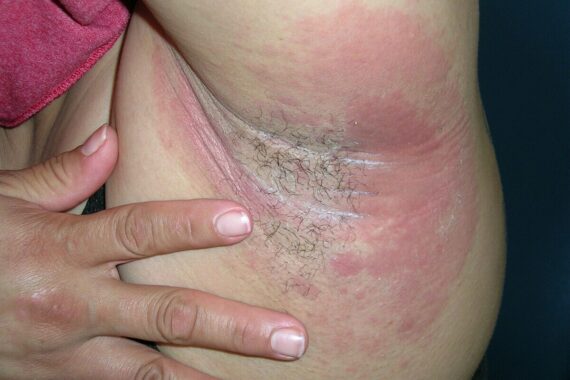
Fast Facts: Flexural psoriasis Definition / diagnostic criteria
Flexural psoriasis (also called inverse psoriasis) is a chronic inflammatory variant of psoriasis that predominantly affects skin folds, including the axillae, groins, inframammary folds, natal cleft, umbilicus and genital region. Unlike classic plaque psoriasis, lesions are typically smooth, shiny and well-demarcated with little or no scale because moisture and friction remove surface scale. Diagnosis is clinical and is supported by symmetrical distribution, sharply defined erythema, chronic relapsing disease, a personal or family history of psoriasis, and evidence of psoriasis elsewhere such as scalp involvement, nail pitting or typical plaques.
Epidemiology
Flexural involvement occurs in around 20–30% of people with psoriasis at some point during their disease course, although it may occasionally present as the predominant manifestation. It affects men and women equally and may occur at any age. Obesity, diabetes and excessive sweating increase symptom severity because friction and moisture promote irritation and secondary infection. Genital involvement is common and can have a marked impact on quality of life despite limited body surface area involvement.
Diagnosis
Clinical features
Patients usually complain of soreness, irritation or itching rather than thick scaling. Examination shows symmetrical, well-demarcated, bright red or deep pink plaques within flexures. The surface appears smooth, moist and shiny. Fissuring may occur, particularly within the natal cleft or beneath the breasts. Scale is usually absent or minimal.
Important clues include:
psoriasis elsewhere (especially scalp, elbows or knees) nail pitting, onycholysis or subungual hyperkeratosis family history of psoriasis recurrent ‘fungal infections’ that fail to respond adequately to antifungal treatment.
Secondary candidal infection may coexist and should be considered if satellite pustules develop.
Investigations
Diagnosis is usually clinical and investigations are rarely required. If the diagnosis is uncertain:
skin scrapings for fungal microscopy and culture may help exclude dermatophyte infection swabs may be indicated if secondary bacterial infection is suspected skin biopsy is rarely required but demonstrates features typical of psoriasis if performed.
Differential diagnosis
The principal differentials include:
Tinea cruris – often unilateral or asymmetrical with an active scaly advancing edge and central clearing. Candidal intertrigo – moist erythema with characteristic satellite pustules. Seborrhoeic dermatitis – less well-defined erythema with greasy scale. Erythrasma – brown-red patches with coral-red fluorescence under Wood’s lamp. Contact dermatitis – often associated with a history of new topical products and less sharply demarcated inflammation.
Failure to improve with appropriate antifungal therapy should prompt reconsideration of flexural psoriasis.
Treatment
Management aims to control inflammation while minimising steroid-related adverse effects in thin flexural skin.
First-line treatment usually consists of:
regular emollients a short course of a mild- to moderate-potency topical corticosteroid once daily during flares vitamin D analogues (such as calcipotriol) or topical calcineurin inhibitors (tacrolimus or pimecrolimus) as off-label, steroid-sparing options where appropriate, particularly for recurrent disease.
Combination corticosteroid/calcipotriol preparations are generally avoided in flexures because of increased irritation.
Patients with extensive disease, difficult-to-control flexural psoriasis or significant impairment of quality of life may require dermatology referral for phototherapy or systemic therapy, including biologics.
Potential secondary fungal infection should be treated if present rather than assuming all erythema is psoriasis alone.
Prognosis
Flexural psoriasis is usually a chronic relapsing condition. Although lesions often respond rapidly to topical treatment, recurrence is common, particularly in warm weather, obesity or areas subject to friction.
Long-term prognosis is generally good with appropriate maintenance therapy, but repeated use of potent topical corticosteroids should be avoided because flexural skin is particularly susceptible to atrophy and striae.
Successful management often requires treatment of concomitant psoriasis elsewhere together with weight reduction where appropriate.
Further reading
NICE Clinical Knowledge Summary. Psoriasis. Updated 2025. Primary Care Dermatology Society. Clinical guidance. Psoriasis: flexural and genital psoriasis . 2021 British Association of Dermatologists. Patient Information Leaflet. Psoriasis: an overview . 2023 National Psoriasis Foundation. Inverse psoriasis . 2026 Menter A et al. Joint American Academy of Dermatology–National Psoriasis Foundation guidelines of care for the management of psoriasis with topical therapy . J Am Acad Dermatol 2020;82:1445-86