

UKHSA discovers disease-carrying mosquitos in England
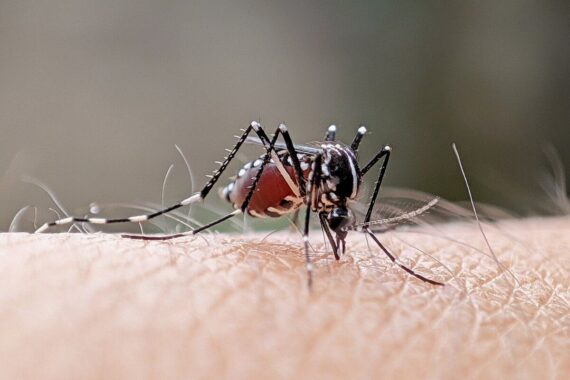


Two-species of mosquitoes that carry several diseases have been found in England, UK Government scientists have warned.
Aedes aegypti and Aedes albopictus mosquitoes are vectors of diseases that include dengue, yellow fever, chikungunya and Zika that had been limited to tropical and sub-tropical regions but in recent years had established in parts of southern and central Europe.
Now the UK Health Security Agency has discovered invasive mosquito eggs in traps in London and in Kent.
There is no evidence that either are widely established in the UK but ‘their detection highlights the importance of ongoing, enhanced surveillance to reduce the risk of mosquito-borne diseases’, the researchers said.
The traps are set in 117 locations around England, Wales and Northern Ireland.
Those at seaports, airports, and highway transport hubs are examined every two weeks, between May and October, each year but in 2020, 2021 and 2022 no eggs were found.
In September 2023, Aedes aegypti eggs were detected in a freight storage facility near Heathrow Airport.
Then in August 2024, Aedes albopictus was detected in a trap at a service station along the M20 motorway in Kent, in South East England.
Measures were put in place to reduce the chance of larvae and enhanced surveillance done where there were no more sightings.
Study lead Colin Johnston, senior medical entomologist at UKHSA, said: ‘What stood out during this surveillance was how dynamic and responsive our work needs to be.
‘Each detection triggered enhanced local surveillance and control measures, and the fact that no further specimens were found suggests these were isolated incursions.
‘The collaborative efforts between UKHSA, local authorities and landowners were key to rapidly mobilising and preventing the establishment of invasive mosquitoes.’
In August public health officials announced an almost tripling of cases of chikungunya in England after travellers caught the infection abroad.
The 73 cases in the first six months of 2025 was the highest ever seen in England but reflects ongoing outbreaks overseas.
Visit Pulse Reference for details on 140 symptoms, including easily searchable symptoms and categories, offering you a free platform to check symptoms and receive potential diagnoses during consultations.
Related Articles

READERS' COMMENTS [2]
Please note, only GPs are permitted to add comments to articles







Overseas travellers arriving in UK should be quarantined at the port of entry for 40 days.
Absolute minimum of 2 weeks.
Disease spread in UK would then fall to what it was before 1900.
They can afford it, if they can afford overseas trips – it is an integral part of the cost to those who travel too frequently.
“Disease carrying” but not actually carrying disease, a blatantly misleading headline.
Mosquitos present in Europe for years without bodies piling up in the streets.
The control freaks in Public Health are a bigger threat.