

LMCs demand UK Governments agree ‘safe limits’ to GP access
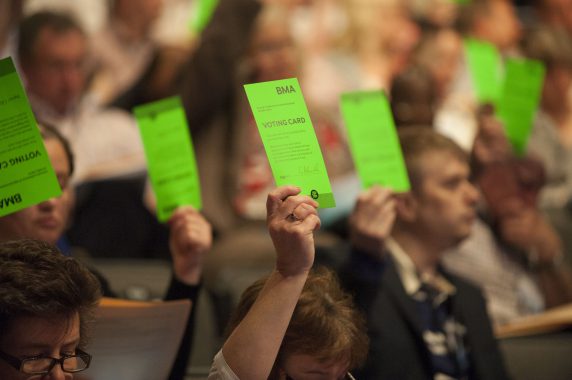


UK GP leaders have asked the BMA to lobby governments to agree clear limits to GP access, and offer legal support to practices who take steps to limit workload.
At their conference in Belfast today, LMC representatives from around the UK voted in favour of a motion insisting that ‘agreed safe limits’ are adopted by governments, commissioners and NHS bodies as the basis for all access, performance and contractual requirements.
They said that ‘no scheme should assume activity beyond these thresholds without commensurate workforce and funding’.
The motion also called for a ‘defined mechanism’ for LMCs to support them to cap demand, restrict registration or reconfigure services on patient safety grounds, without contractual sanction.
It called for clear medico legal guidance for GPs who take steps to limit ‘unsafe’ workload, including support where practices or individuals are ‘challenged for prioritising patient safety’.
It comes as the BMA is currently coordinating collective action in England in protest at unlimited access as stipulated by the imposed 2026/27 GP contract.
As part of the contract, GPs in England have to ‘deal with’ all urgent patient requests on the ‘same day’.
Proposing the motion, Dr Eithne Macrae, from Mid Mersey LMC, said: ‘How on Earth can we work safely with limitless access and demand, plus the requirement to respond within 24 hours for routine and see 90% of urgent on the same day?
‘There is no flexibility at all to handle a seriously unwell patient, safeguarding concerns and mental health crises.
‘This contract change has worsened access as appointments are reduced to deal with increased triage. We must cease to be the dumping ground for service provision failures elsewhere in the NHS, patients must be educated on where to access help for concerns that fall outside the remit of the GP.’
The conference also voted in favour of another motion around safe working, proposed by Leicester, Leicestershire and Rutland LMC, which demanded funding and contractual mechanisms that allow practices to ‘meet minimum safe working standards’, and opposed contractual requirements that mandate increased access ‘without corresponding resource’.
Dr Fahreen Dhanji, who proposed the motion, said: ‘Safe working is not a preference. It is not a long term aspiration. It is a fundamental requirement for patient safety and for protecting the very workforce that sustains the NHS.
‘Yet right now, safe working limits are not meaningfully embedded in general practice. Instead, we have a system that expects rising demands to be absorbed without corresponding increase in staffing, funding or contractual flexibility. That burden is carried every single day, not just by GPs, but by the entire practice team.’
The motions in full
AGENDA COMMITTEE TO BE PROPOSED BY MID MERSEY: That conference believes that current workload in general practice is unsafe for patients and GPs, and that the absence of clear limits enables ongoing exploitation of the profession. It therefore:
(i) calls on the GP committees of all four nations to agree and publish evidence-based guidance on a safe maximum number of patient facing consultations per whole time equivalent GP per day, and a safe maximum patient list size per WTE GP, explicitly adjusted for deprivation and case mix TAKEN AS REFERENCE
(ii) insists that agreed safe limits are adopted by governments, commissioners and NHS bodies as the basis for all access, performance and contractual requirements, and that no scheme should assume activity beyond these thresholds without commensurate workforce and funding CARRIED
(iii) demands that where practices are persistently operating above agreed safe limits, there is a defined mechanism for LMCs to support them to cap demand, restrict registration or reconfigure services on patient safety grounds, without contractual sanction CARRIED
(iv) calls for clear medico legal and professional guidance for GPs who take steps to limit unsafe workload in line with these thresholds, including collective support where practices or individuals are challenged for prioritising patient safety CARRIED
AGENDA COMMITTEE TO BE PROPOSED BY LEICESTER, LEICESTERSHIRE AND RUTLAND: That conference notes that
GP practices are expected to deliver care in environments that are increasingly unsafe due to excessive workload, inadequate staffing, and insufficient funding. Conference is concerned that despite safe working limits being a fundamental requirement for patient safety, they are not embedded in general practice across the UK. Conference calls on the BMA to
(i) ensure workload limits reflect consultation complexity and supervision responsibilities CARRIED
(ii) demand funding and contractual mechanisms that allow practices to meet minimum safe working standards, opposing contractual requirements that mandate increased access without corresponding resource CARRIED
(iii) support practices who refuse unsafe working conditions that arise as a direct consequence of systemic underfunding CARRIED
(iv) lobby UK governments and NHS bodies to ensure that when practices reach safe capacity, excess demand is met by appropriately commissioned alternative services, rather than being absorbed by general practice CARRIED
(v) lobby UK governments to move away from access / volume metrics and move towards activity-based performance measures that value continuity, expertise, and population health outcomes. TAKEN AS REFERENCE
Related Articles



Most





IMPORTANT LINKS
MORE FROM COGORA
© Cogora 2026
Cogora Limited. 1 Giltspur Street, London EC1A
9DD Registered in the United Kingdom. Reg. No. 2147432
