

Baroness Gerada: ‘General practice is being turned into an acute triage service’
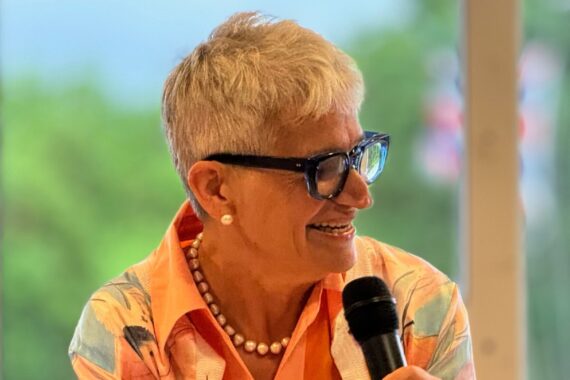


Pulse editor Sofia Lind hosted an on-stage interview with Baroness Gerada of Kennington at Pulse LIVE London on 28 April, asking her about what it is like to be a GP in the House of Lords, whether the assisted dying bill will make a comeback, and how GPs get policymakers to listen
Sofia Lind: What is it like being a GP in the House of Lords?
Baroness Clare Gerada: It’s very strange. I get stopped a lot by people who ask me about their medical issues, and that started almost from the first day. I am the only GP who has been in the House of Lords in my professional lifetime – I know there was one GP in the 1970s so I think I’m only the second proper GP to be there. I say proper because clearly, before the MRCGP exam and before we had proper training, anybody could call themselves a GP! But I’m the second proper GP the House of Lords has ever had.
It means that in more or less every single debate, there is an issue is of relevance, and so I have had to focus myself. But it is a scary place. I feel a little bit like I’m the sort of grammar schoolgirl that’s just been put into Eton. It’s very strange. In the first few weeks, I got lost so many times; I ended up finding myself in a chapel somewhere in the House of Commons with no way out. Fortunately, there was a cleaning lady there who took me through a disabled lift.
But it is an extraordinary place, and I do feel a real weight of responsibility being there. When I listen to the debates in the Lords I play a sort of bingo game: How many times are GPs criticised? I am now learning how to do points of order – standing up and saying: ‘Well, I’m sure my noble Lord is aware of that…’ But I do feel the weight of responsibility, because although I’m not there representing you – as an elected MP would a constituent – I feel that I am there representing my profession.
Already I think I’ve made a difference. For example, there was a debate on the National Cancer Plan at which I spoke. I gave some stats about general practice, including: the fact that we receive less than 8% of NHS funding – the lowest in a decade; have a flatline number of GPs; and that one in five GPs are unable to find work or are fully unemployed.
Then I added that for £150/patient a year, we see half of the entire UK population every month. Hansard [the official report of all Parliamentary debates] did not believe these figures. When I gave them my speaking notes, they checked the £150 figure, which I confirmed. The woman I was speaking to remarked that she had spent £200 going private for a minor health issue. And I think that’s the difference – the level of knowledge about general practice, what we actually do and how much it matters, is very low.
SL: You were thrown straight into the assisted dying bill debate recently, which obviously came to an end without gaining approval from the House of Lords.
CG: In my interview, applying for the House of Lords, they asked what I could help them with, and I said the assisted dying debate. They mentioned another Baroness who was helping with the bill, and I thought: Well she’s not helping the way I am, because I’m in favour of assisted dying.
I’m sure you all know that there were about 1,200 amendments to the bill; 50% of them were tabled by six peers, of which, sadly, the top person was a doctor. That individual labelled so many amendments and spoke for four hours in total over the whole debate – when you are really only meant to speak for 2-3 minutes.
Those in favour of the bill were told not to speak until the last day because it would just prolong the debate. That final day was the most extraordinary event and even now I shudder to think about it. People were giving their personal testimonies of loved ones dying, of being present at the moment of death, of why they wanted assisted death – even ones that were against assisted dying.
Baroness Hollins talked eloquently about her husband dying of motor neurone disease. He hadn’t seen it as a burden, because we often think of people with MND as a burden. Baroness Hollins also mentioned her daughter who was paralysed from the neck down after being stabbed many moons ago, and she is able to lead a fabulous life.
I spoke about general practice because there was so much misinformation about GPs. I wrote: ‘You’d think that the moment somebody got a terminal diagnosis, we stepped away, stopped communicating, or made all the errors.’ And I made it clear in the debate that this is absolutely not the case – we lean into our patients. We organise care around them. We give them continuity.
SL: Do you think the bill will come back to Parliament?
CG: It will come back. I’m not an expert in policy, but apparently, if there are enough MPs who put it forward as a private members’ bill, then it will come back. And if it comes back, then it doesn’t come back in the same way. They [the peers] have filibustered it. I’m sorry – if it feels like an elephant, smells like an elephant, sounds like an elephant, it’s an elephant. It is filibustering. But [upon its return] I think the bill will pass through.
I do worry though that it will become so bureaucratic that it will be almost unworkable. We looked at evidence. I interviewed some people from Australia and their system – it’s humane. It really is humane if you choose to want to die.
The other thing that [peers against the bill] did was they kept referring to it as ‘assisted suicide’, and one even called it ‘state murder’. It was dreadful, absolutely dreadful. And looking after people who have been bereaved following suicide of a loved one, I found this appalling.
SL: On the topic of pain, GPs’ mental health is something that you have been a very big advocate of, as founder of NHS Practitioner Health and working with Doctors in Distress. What do you think is driving pressure on GPs at the moment?
CG: I’ve looked at all the evidence from the last 25 years, and we know that the only part of the NHS that has seen increase in productivity is general practice. We see 1.2 or 1.3 million patients per day and 360 million appointments per year. Think about that.
I listened to GPC chair Dr Katie Bramall give fabulous evidence at the Lords’ childhood vaccinations committee. She said that if continuity of care was a tablet, NICE would mandate it three times a day. She also gave some stats which I’ll share again: we only have 15% of all NHS staff located in general practice – 80% are located in hospitals. We do – by volume – the majority of the work.
Our consultation rate has increased, the length of time we spend with patients has increased, and the complexity has increased. You know it all. It is no wonder we’re always caught in this vicious circle of wanting to do better for patients – of moral distress – but not being able to.
Everyone always talks about access. I was at a meeting yesterday and they were again bemoaning GPs and access. And I said that it is not an access problem. It cannot be an access problem when half the population consults with their GP every month. Seventy-five percent of patients get an appointment within a week. We know that.
What it is, is a continuity of care problem. And what my worry is, and why I think GPs are miserable, is that we are being turned into an acute triage service, rather than a continuity of care service. And I think we should always use that line: It is not about access. How can it be about access if half the population of Britain access their GP every month? What people really mean is: ‘I can’t get an appointment today.’ Well, they can, as 75% of all appointments are given within a week. So, I think we’re unhappy, because we know our job is the best job in the world – if only we could practise it the way that we need to practise it.
SL: On the topic of access, since October GP practices have been mandated to have their online consultation tools switched on through core hours. You have significant experience here, what are your thoughts on current Government policy and how it could be improved to aid GPs?
CG: Yes, my practice set up eConsult many moons ago. We were sitting on one awful cold April morning when we saw the queue outside the practice. We knew every single patient and knew what they’d all be coming in for. And I said to my partners that I wish I knew what the matter with them was before they came into my consulting room, because then I could put them in the appropriate place. And so we set up eConsult.
With respect to opening all hours, it is difficult. I think that because we are the only part of the NHS that delivers routine care that is open all hours, it does feel like it is discriminatory against us. But I do flip over to patients and think that if you are seeing your elderly mother in the evening and you want to help her with an eConsult, you should be able to send one which then sits in a queue.
But if we have got mandated 24/7 open access, then we need to be using that (and I’m sure our negotiators are) to mandate a shift in resources from hospital to primary care, which is the only way. I think it’s a sort of red herring argument. I think the real argument is, why – if we’ve been saying we need to shift resources into the community since 1946 – have we not done it?
And in fact, it’s heading the opposite way. If I were any of you, I would write to your MPs and ask them to table a question in the House of Commons as to, why is it that we are not shifting resource? All the answers to the problems in the NHS can be resolved by shifting resources to primary care, and mandating no transfer of work from hospital to general practice unless it is unbelievably required and urgent.
If I was a negotiator now, that is what I would be doing; no mandating and no cross work. They can tell us what’s going on, but they can’t ask us to do something. They need to take responsibility for their prescriptions again, follow up for their blood tests again and organise repeat appointments again – which is how it used to be.
SL: So how can we get the Government to understand general practice?
CG: I’ve been everywhere. I’ve been a jobbing GP, I’ve been chair of our LMC, RCGP president and more. And I can see now what’s missing and that is a real understanding from those in power – MPs and lawmakers – of what we really do.
I’m also giving evidence at the Lords’ childhood vaccinations committee. I thought Dr Bramall and Professor Tzortziou Brown’s evidence was so good, I went up to the chair and said to her that she had heard some pretty good evidence about general practice. She agreed and pointed out that I had also given the same evidence in the cancer debate. So twice in one week they had heard us, and they had directly linked the problems with vaccinations that we’re seeing now with the workload issues of GPs – because we are not able to do what we want to do, which is chase and innovate. And so, my feeling is that we have got to talk to the right people.
We also need people to see what a week in the life of an average GP looks like, as I don’t think I have seen it anywhere. I want to know how many appointments, how many tasks, how many people interact with you, how many telephone calls, how many letters you receive etc. All of those can then be turned into questions, which can then end up in Pulse.
There was an article in the Health Service Journal which was directly because of questions that I raised in in the House of Lords about the numbers of GPs compared to hospital doctors over the last decade. So, I need your help in order to ask the right questions. Because I’m in there, I have direct access to these spaces, which I don’t think we had before.
Question from audience: How do we train future GPs with regards to AI?
CG: I think with AI we all have to train ourselves. About five years ago, the Daily Mail asked me to look at 10 consultations and the responses, and guess whether they were done by a human or AI. I got them all right. They repeated it this year with different cases and I got them all wrong.
One answer was so bad, I said that if this is a human that has written this response, then they are disrespectful to GPs – and in fact, it was a human that wrote that response. The better responses were all done by AI – so I think we have to learn how to use AI. I think it’s not just for patient end, it’s also for us, because, as at the patient end, AI always says: ‘See your health professional.’ And so it is for us as a differential: Have we remembered this? Have we done that?
We’re all learning how to use it, and I think we can’t be frightened. It adds grist to us, because when you’re getting your DNA tested and your gene profile, the only people in the whole of the health system that can translate that meaningfully for each patient is us. You’ve got a 50% chance of getting dementia. Well, you’ve also got a 50% chance of not getting dementia, you know what does it mean? So, it is about training, but I think it goes back to time and continuity.
You can listen to the Big Interview with Baroness Gerada, as well as clinical highlights from Pulse LIVE London, on the most recent episode of our podcast.
Continue your learnings by registering for our upcoming virtual events. Our one in May being on Chronic Conditions, Dermatology and Diabetes, and our June one being Pulse Virtual: Women’s Health, Urology and Dermatology. These events are designed for GPs and primary care professionals seeking practical, CPD-accredited clinical updates and expert-led insights they can apply straight into everyday consultations.
We’ll also be travelling to Birmingham, Newcastle, Cardiff, Glasgow, Belfast and Liverpool this year, delivering our Pulse LIVE Events. Book your free place today.
Have you got a view you want to share with Pulse?
We’re always open to first-hand pieces and opinions from GPs.
Email your piece for consideration to be published on our site.
Related Articles

READERS' COMMENTS [2]
Please note, only GPs are permitted to add comments to articles







It has been raised countless times, that the RCGP has over decades has abjectly failed to represent General Practice effectively focussing on its own needs, superfluous titles in my humble opinion as a paying member for decades. The RCGP in lead position, is directly responsible and culpable for the lack of understanding of the public and government, of what General Practice as a specialty actually is and hence for the ongoing decline of this profession. Hopefully they will now try and cover their decades of ineffectual ramblings and undertake the additional role in which they have to date failed in my view by actually raising awareness of what actually constitutes the workings and activities of General Practice and we will finally see some actual RCGP leadership absent for most of our lifetimes imo.
Now we are told that that members of the House of Lords have little awareness /knowledge of GP circumstances.
How many visit after visit after visit have these RCGP leaders made over the last decades to MPs, committees and parliament at members expense?
How long have the inhabitants of our not so esteemed House of Lords being present to absorb any information provided by these so called RCGP leaders?
What was the purpose then of all these visits and how do current /former RCGP leaders explain this and in the disparity between the RCGP information regarding their government discussions and the lack of knowledge within parliament ?
Why should the profession trust the RCGP to represent GPs now they are able to sit at the table with or instead of the BMA?
Something perhaps seems not quite right in respect of the RCGP and House of Lords in my very humble opinion.