

GPs don’t need to be ‘100% sure’ of patient cause of death, says medical examiner
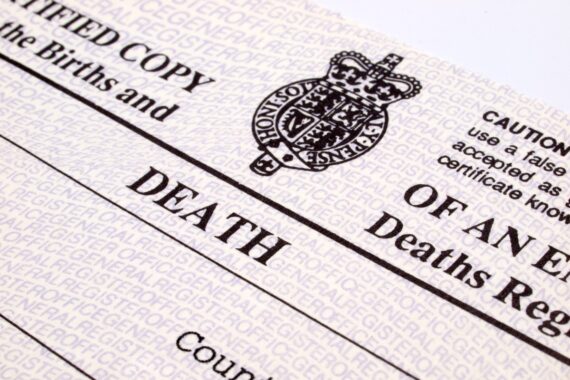


Exclusive GPs don’t need to be ‘100% sure’ of a patient’s cause of death when signing a death certificate – but should be able to explain their clinical reasoning, a medical examiner has said.
Dr Faheem Shakur, a GP partner in Blackpool and a medical examiner, told Pulse LIVE London that GPs should be able to explain the ‘logical sequence’ of a patient’s death in support of their clinical reasoning.
And, he added, GP ‘apathy’ is not a good reason not to provide a cause of death.
The most recent change to the death certification system was implemented following several delays in September 2024, requiring GPs to agree death certificates with a medical examiner.
Dr Shakur said: ‘There are times when you don’t actually know [the cause of death], but that is different to “I’m not 100% sure”. No one’s asking you to be 100% sure.
‘You don’t need to be fully 100% sure as to the cause of death, but you need to have a good chance of knowing what is. And it’s having a logical sequence to explain that reasoning, clinical reasoning. But it shouldn’t just be apathy as to why [GPs] can’t give a reason.’
However, Dr Shakur also stressed GPs should be cautious when signing off in ‘grey zone’ cases – such as falls in elderly patients, sudden deaths at home, or where there are incomplete records. He warned against attributing frailty or old age ‘just because’ a patient is over a certain age.
Guidance from the Department of Health and Social Care last year advised GPs to avoid attributing ‘old age’ alone as a cause of death.
Dr Shakur said: ‘Think carefully. Don’t put frailty or old age just because they’re over 80 – you won’t always get accepted [by the medical examiner’s office]. It might be a quick time saving thing, but that’s not how this works.’
GPs have a duty to refer to a coroner if they cannot establish a cause of death, but Pulse has recently reported on practices coming under greater pressure to complete death certificates when unsure of a patient’s cause of death, since the changes were implemented in 2024.
Last month, a coroner criticised GPs for their ‘reluctance’ to provide causes of death, claiming it was causing ‘distress to bereaved families’.
Senior coroner for Cheshire Jacqueline Devonish took the step of telling GP leads in the county she would not accept referrals where GPs were unable to provide a cause of death, if she was ‘not satisfied’ they had properly engaged with a medical examiner.
When asked by Pulse about the coroner’s argument in this case, Dr Shakur said GPs should try to ‘see it from both sides’.
He said: ‘Obviously you shouldn’t feel time pressured [by coroners], but you have to see it from both sides.
‘There is a family grieving, and I mentioned in my talk the faith deaths, in particular, where it’s quite important for a family to do a quick burial, so understand the setting where they’re coming from.’
The free-to-attend Pulse LIVE London conference, worth up to nine CPD points, takes place today and tomorrow (28-29 April) at the Business Design Centre in Islington.
The clinical agenda includes: AI in obesity management, urology, PCOS, proactive frailty management and more. The full agenda can be found here.
The Pulse LIVE roadshow will be travelling across the country throughout 2026, with events in Birmingham, Newcastle, Cardiff, Glasgow, Belfast and Liverpool.
Discover our programme of free, CPD-accredited events – delivered face-to-face and online – designed to bring you practical clinical updates and expert-led sessions. Book your free place today and join us in person or virtually.
Visit Pulse Reference for details on 140 symptoms, including easily searchable symptoms and categories, offering you a free platform to check symptoms and receive potential diagnoses during consultations.
Related Articles

READERS' COMMENTS [9]
Please note, only GPs are permitted to add comments to articles







It could happen this year or in 10 years time, but eventually there will be a crisis linked to a less than robust certification process.
When that happens comments from coroners encouraging GPs to just sign off old people without any thought or investigations; primarily to reduce their workload; will age like milk in the Sahara.
It is totally inappropriate for pressure to be placed on GPs, by coroners (not by this ME) to complete MCCDs when they are not comfortable. That is of course not the same as being 100% confident, but the pressure is unacceptable, always.
It is unusual for actual coroners to make such comments as the coroner for cheshire has made. They are then an easy scapegoat when as the experienced know ‘stuff’ happens.
The pressure most usually comes from less senior members of the team, the coroner’s officers, it is these that speak to GPS.
They feel pressure to not put too much work into the system, and have to try to reduce use of PMs, Inquests and coronial process.
One has to wonder how many murders we miss…
I think like this because my dad worked in forensic pathology so during my childhood about once a month he would disappear off to a an unexplained death scene. Many would turn out to be suicide and rest murders. In the 1970’s mostly dosmetic. As a 6th former I had summer jobs in the Sheffield city mortuary in the medico-legal centre which would take all sudden deaths and we would have about 6 PMs a day in the winter. I recall burns victims, RTA victims, dropped dead in the street, jumped off a train, drownings Etc.
I would also say that a PM doesn’t always guarantee a cause of death.
I believe many have been pressured to sign death certificates by MEs where the cause is unknown or uncertain and in my opinion, to essentially fabricate a cause of death. These case perhaps all need reconsideration. This is a scandal which we all see evolving yet vested interests and the unfortunate desire to be less than open, raises its head. We all know case where ‘ heart failure ‘ etc is not accepted in past times and the underlying reason for the HF is required etc. yet there seems to be no restriction on MEs attempting to coerce GPs to fabricate a cause of death based on dubious information. Does this really reduce the risk of Shipman type events or increase this risk. It ramps up this risk massively in my view but once again I am sure MEs would not want to give up this very niche and lucrative role.
Further to the above, this does make the national statistics meaningless where causes of death have simply been ‘created’ although occurring to some degree in the past but far more so with MEs in my opinion.
There is literally zero chance that I’m going to append my name to a diagnosis that is essentially a guess by someone who has not seen the patient when I, who has, do not know what ended their life and could not state in Court that I did.
I thought post-Shipman we wanted to be MORE sure that patient deaths were explained?
Rapidly increasing race to the bottom continues a pace
WTAF!
Interesting discussion. I suspect much of the tension here reflects a wider discomfort within modern medicine around uncertainty itself.
Death certification has never required absolute certainty in every case, but it has always required honest clinical reasoning, professional judgement, and the ability to justify an opinion based on the available history and circumstances. That is very different from “guessing”.
At the same time, it is entirely understandable that many clinicians feel anxious practising in increasingly scrutinised systems where nuanced probabilistic decisions can later be examined through the lens of hindsight.
Perhaps the challenge is finding a balance that preserves both appropriate caution and the practical reality that medicine rarely deals in absolutes.