GPC Wales chair Dr Gareth Oelmann: ‘It is all about the money’
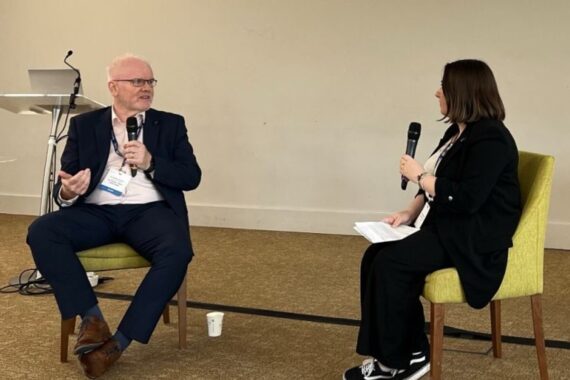


Pulse’s Anna Colivicchi sat down with Dr Gareth Oelmann, the chair of the BMA’s GP Committee in Wales at Pulse LIVE Cardiff on 2 July, asking him about the need for more GPs and an increase in funding to general practice; and why contract negotiations have been delayed amidst the transition of governments
Anna Colivicchi: At the Welsh LMC Conference, you said that the message ‘invest in general practice, it benefits the entire NHS’ landed with the previous Government. Do you think it has landed with this new Government? And what are your first impressions of this new Government?
Dr Gareth Oelmann: I think that in general GPC Wales and BMA Cymru Wales have launched a longitudinal campaign. When I first started in the role, I met with many of the health spokespeople for the various parties, and the level of understanding of general medical services was very low. Through the Save Our Surgeries campaign which we started three years ago, and through the work that you, as practices, the LMCs, and GPC have done in a professional, political, patient arena, we have managed to raise that understanding of the need.
After the petition, that then culminated in the Senedd Health Inquiry into the funding of general practice, which was published in the dying embers of the last administration. I’m sure many people have seen that and read that with interest, but I think that that showed that the level of understanding the need and the role of GMS and general practice within the NHS in Wales has certainly improved.
With the new administration it is very early to say as they are still within their first 100 days and have set themselves lots of challenges within that time. But actually the role of improving that awareness and setting that groundwork with Plaid Cymru started right at the beginning of the Save Our Surgeries campaign, and actually Rhun ap Iorwerth sponsored the first Save Our Surgeries event in the Senedd back in 2023. Mabon ap Gwynfor has also been very much involved in the inquiry, so we would hope that he should understand [our perspective] because he helped write it and form the report.
So, I think there’s a very good foundation, and relationships already exist with the new administration. But as I said in my speech from the Welsh LMC conference, the new administration needs to be judged upon actions, not rhetoric. I think the opening signs, the signalling of their listening and understanding is there. We need to build upon that.
AC: Before this Government came into power, the BMA wanted a GP-specific workforce plan and said that the new Government must put that in place. What would you like to see as part of that plan, and do you think it’s going to happen? Also, this Government has also now committed to a review of how GP funding works – what would you like to see from that?
GO: I will keep on referring to the Save Our Surgeries campaign because it is the basic tenet and pillars of everything we’ve done. We have called for a resource restoration into general practice. I think everyone in the room – including politicians – has to be cognizant of the differences. The health boards need to be very aware of the differences between investment into primary care, investment into general practice and investment into GMS.
As GPs we do more than just GMS. GMS is part of what we do, and it’s the contractual construct around that. There has been talk in the last week from Plaid about an increase of 0.5% of the overall NHS budget [going] into primary care from health boards – from the taxpayer.
There needs to be methodologies of ensuring that it arrives in primary care, but [we are] yet to find out how that materialises. With general practice just being part of primary care, [we need] to ensure that the health boards understand what we believe, and I believe in ,which is that general practice and GMS as a construct actually forms the bedrock. [We provide] 90% of consultations for currently 6% of the total NHS budget, and the Save Our Surgeries campaign will have asked for [it to be restored] to previous levels of 8.7%.
That would be 300m pounds which is 50% of our current GMS contract – worth about 650m pounds. The total NHS budget in Wales is 12bn pounds.
My job is to represent general practice and GMS – not primary care. We are part of primary care, but they have other representatives that can advocate for them. So, I will unashamedly be looking for a share of the 100m pounds that Plaid have announced will go towards waiting lists. There are lots of things that general practice and GMS could be doing at a fraction of the cost very efficiently.
I would say in the planned care journey, patients start with us, we lend them to secondary care for a while, and they then give them back. It’s very important that we are not ignored when it comes to money; as maybe we were when national insurance contributions went up from the central treasury, and when there was investment into the NHS in Wales – but it was mainly spent on secondary care waiting lists with a small amount remaining for outpatient waiting list initiatives.
As for your question on the workforce plan – we need more GPs. It was the second recommendation from the Save Our Surgeries report. We know from the data that compared to the OECD average, we are probably 660 FTE GPs short of the average across Europe. But the ability to employ GPs is constrained by the finances within the practice.
As anyone who has listened into the oral evidence for the health inquiry, they will know that I have said repeatedly: It is all about the money, it is all about the money, it is all about the money. But the constraint is there.
So, with workforce planning, I wouldn’t necessarily confine GMS funding to just GPs – we are all part of a bigger multidisciplinary team, and there are lots of roles and resources that we need within our own practices that aren’t just necessarily GPs. But the BMA is a doctor’s organisation, so primarily I will look for that.
With regards to GMS investment into the workforce, Scotland’s recent contractual deal included money for workforce – primarily to be used for GMS. And in England they received funding through the additional roles reimbursement scheme. There [previously were] a lot of restrictions but as you will have seen in the workforce fund and the investment that has been given this year, there aren’t restrictions.
It is for practices to determine how that 100% reimbursement is spent, and I think that is important because you, as individual practices, will understand what you need within your organisation to actually augment the team. It may well be GPs, and I will always advocate for more GPs. We know there is GP underemployment and unemployment – so the workforce is there.
If the funding is given to general practice, to GMS, then we will find the workforce, and we can provide capacity. Then they [will still] argue about access, but access is just a product of capacity, so it all comes down to the money.
AC: Last year the BMA reached a deal with the Government on the contract, and it included some elements of this year’s contract as well. What point are the negotiation for this year’s contract at?
GO: It is a very valid question. I’d like to know where we’re at with that as well. As soon as I know, I’ll let you know.
I think many of you will understand the evolution of recent contractual negotiations, how they’ve been delayed and delayed and delayed. My first year of negotiation [resulted in what] I would call an imposition that wasn’t imposition, where Eluned Morgan gave us the money without any contractual change. [They] didn’t want to call it an imposition, but there was no agreement.
The year after, things went on and on and on, and then there was a non-recurrent stabilisation fund. That was a lot of money, but it was non-recurrent which is not an acceptable way to do business. But when it is that significant an amount of money, you cannot say no on behalf of all the practices in Wales.
This year’s negotiations were again delayed, but I think that when they came out, they were meaningful, and timely – as promised by the Government. But as I have said before, I would prefer that negotiations took a little bit longer and that it was right and worthwhile; rather than rushing something that would be insignificant
But as part of the 2025/26 deal was an announcement of 5.8% ring-fenced investment equivalent to 5.8% of the GMS contract value, which was for preparedness towards community by design. That money you will have already seen the first tranches of it split in thirds, a workforce fund 100% reimbursed, the money that went into the resilience into the GMS.
The bit that everybody is asking me about is the Transformation Change Fund, and what is going to involve? That is still with the legal teams of Welsh Government. There are many reasons why it has taken so long, and I think we are just about to formally write out to the practices to explain that there has been a delay in that – some of which is due to the change in the administration.
That’s why we accepted the money, because we knew that without an upfront amount of money practices would have been struggling with cash flow issues all the way through from April. I know it’s unacceptable that that money is received for that financial year for the contractual offer in February/March time of the year. It is backdated, though it doesn’t help.
We are going through a change of administration [which makes things slightly challenging]. Very kindly, Jeremy Miles left us with a two-year deal on his way out, which I think gave some stability to practices from April, and the money just started to flow. We still need to know what that transformation fund is going to mean in reality: How practices are going to access it; what it’s going to do; and what you’re going to be expected to do for it.
The actual question is what is happening with contractual negotiations for 2026/27 because that 5.8% – an equivalent amount of £32m – was over, above and separate to DDRB, and to pay expense also for the staff expenses, general expenses and contractual change.
Those negotiations haven’t started. You can only negotiate with the with the current government, and there’s that transition period. Just today I received an invite from the health minister’s office to discuss an approach towards negotiations, and that will start next Monday.
It is, however, unacceptable that we are the only branch of practice that a DDRB pay award uplift is contingent upon contract negotiations. That is wrong. Every year we ask for a decoupling of pay awards from contract negotiations, but those that listened to Jeremy Miles’s oral evidence at the Senedd Health inquiry will know that he said that is the lever that they have over the negotiations. So that is where we are. We keep on saying that it is unacceptable that it is delayed – we are no different to any other branch of practice.
Audience question: Now that the Senedd inquiry has said that the Carr-Hill formula is not fit for purpose, will the contract now acknowledge that it should not be a factor in funding?
GO: I am very cognizant of the effects of Carr-Hill, though I think I have to call it a global sum allocation formula, because there was a lot of political interference with the original Carr-Hill formula.
I spoke about the allocation formula at the UK LMC conference, about needing reform of funding in terms of quantum and allocation. We’re aware that lots of different groups are calling for reform and review. There are issues in urban, rural, deprived and multi-site practices. Everybody, to a degree, because of the nature of the metrics, is affected differently; and therefore, even though everybody is calling for a review, they would all like a different end point.
I feel that my job at GPC Wales is to represent our 360 practices and ensure that there is a review. We have asked for a review many times over many years within our contractual mandate requests but that has fallen upon deaf ears. We are aware that moving money through QOF – although qualified and simplified – was part of a bigger package of the stabilised contract, but it affects the stabilisation fund – the non-recurrent one I mentioned earlier. We asked for it to be non-weighted and that was not accepted.
Negotiations are compromised. As I tell my kids at Christmas: ‘If you don’t ask, you won’t get; but just because you ask, doesn’t necessarily mean you’re going to get it either’. I think negotiations are like that. It’s not that we aren’t aware, and it’s not that we haven’t asked.
I hope that you will have seen in the recent announcements there is a degree of movement in some of the sums of money through the different funds that I’ve talked about. Some of them have been weighted, some of them are non-weighted. Some money has been put into [quality improvement] projects, supplementary services – or we haven’t put money into supplementary services because they are so volatile. Some have been removed as they were underfunded anyway. So, we are working through a review of all the supplementary services; there is a contractual commitment to review the allocation formula.
We’ve already been meeting with the representatives and academics, looking at what that may look like, how that may be done and recommendations. I signed a contract with an outgoing administration; now we’ve got a new one, so – what I need is a political commitment. I think that it is there and having listened to the health secretary, he has already committed to that in the chamber in plenary, but I’d like to see it written in words. I want to know exactly how that’s [committed for an] independent review into the allocation formula.
None of this is going to be quick. I lived through MPIG – including its withdrawal – and I wouldn’t necessarily like to go back there. I think it had its faults and failures but [ultimately] put up barriers towards practice innovation. So, we [need to think about whether] that is a solution we want to replicate.
But what we need from a negotiated review, is to ensure that practices have a fair outcome, but we can’t necessarily see the total destabilisation across Wales that has a domino effect. So, we must be very careful of the unintended consequences. It is going to take time. I know that people will turn around and say ‘England has said they’re going to do it in six months’. Well, let’s wait and see.
I think there will be an announcement coming out soon. We know that Scotland did an allocation formula review several years ago, and they’re not entirely happy with what happened there. We know that we’ve got a workload formula that doesn’t necessarily work, the metrics being applied within that formula are old which is an issue. There are lots of people calling for needs-based formulas.
We really have to see. I think there are hybrids of both approaches for unavoidable costs as well as what is workload, what is need, etc. A lot of it needs to be worked through. It needs to be done carefully. In a zero-sum game there will be winners and there will be losers; but it must be fairer.
Audience question: My trainees who are coming out now of ST3 have no jobs to go to. How have we gotten to a situation where there are no jobs for GPs? We would love to take them, but we cannot afford it. How will this be highlighted to the health ministers?
I know I keep referring to it, but the three pillars of the Save Our Save Our Surgeries campaign were workforce, workload, and well-being. [The workforce situation] is a paradox – it does not make any sense. When statements about it were made at the inquiry, politicians also couldn’t make sense of it. It is about the funding, quantum and allocation which all needs to be addressed.
Through the inquiry, the evidence and the longitudinal education of those politicians, I would like to think that the message is starting to bear some fruit. I think we are at an inflection point and things are improving. Take the workforce fund as an example, of £10.2m, and what that means to you as an individual practice. But if you put that purely into GP FTE numbers (we talked about being 664 short of the OECD average) that probably equates to about 100 GP posts.
It’s a start. It’s not as far as we want to go, and we will keep on asking for more money, because it is workforce that is going to drive the left shift of services. We feel that we’re efficient and dynamic, but I won’t let us be cheap and underfunded. If that 0.5% coming into the community is going to see its way into general practice, there needs to be a workforce.
You’re right, in that we feel there is a trained workforce [ready]. It’s the economics of the madhouse that the taxpayer will pay £250,000 to train a GP and then let them go elsewhere. It just does not make any sense. I’ve made the argument that we need to push more money into workforce. Resources need to follow the cost, so if there’s work that’s coming out into general practice and the community, then the money needs to follow it and part of that needs to be to provide the workforce.
This interview has been edited for brevity and clarity

You can listen to key outtakes from our interview with Dr Oelmann – as well as new GPC England chair Dr Clare Bannon – on the latest episode of our podcast.
Pulse LIVE will also visit Newcastle, Glasgow, Belfast and Liverpool this year. Book your free place today.
Have you got a view you want to share with Pulse?
We’re always open to first-hand pieces and opinions from GPs.
Email your piece for consideration to be published on our site.