
‘Our sitcom is a love letter to the profession’
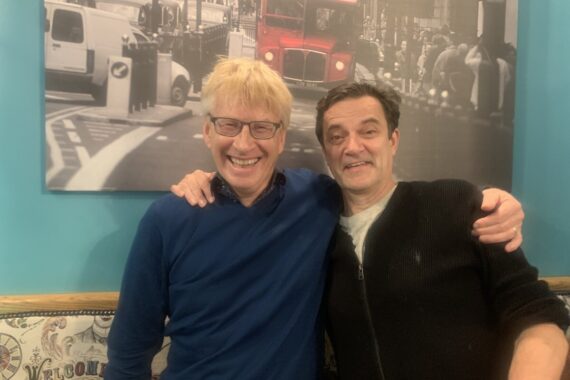


‘Doctors on Hold‘ follows a small ‘failing’ GP practice through the eyes of its staff as they weather the absurdities of modern day general practice. Private Eye columnist and retired GP Dr Phil Hammond sat down with Pulse to reflect on ‘laggards’, AI triage, Copperfield and why his new Radio 4 sitcom with fellow former GP Tony Gardner is ultimately a love letter to the NHS’s forgotten front door
How did this series come about?
Dr Phil Hammond: Tony [Gardner] and I started doing comedy at the Edinburgh Fringe in 1990. Our first Radio 4 series [Struck Off and Die] ran from 1993 until 2000. Tony then gave up medicine and went into acting; I decided to stay as a doctor. That essentially spelled the end for our duo, but I had always hoped we would get together again to work on something different.
He went on to have a busy acting career, and I did lots of comedy on my own. But we got together again when I did this Radio 4 thing called ‘How I ruined medicine’ in 2023, and started chatting and listening to old sketches. It got to the point where we thought: ‘Wouldn’t it be fun to have another go?’
So, we pitched our new idea, set in a GP practice, to radio and got the go-ahead for five 15 minutes-slots.
You and Tony have both worked as GPs, so it makes sense as to why you would want to write about general practice. But why do you think it was commissioned – why would anyone else be particularly bothered about a series set in a GP practice at this moment in time?
PH: Well as the ubiquitous Tony Copperfield would say, general practice doesn’t get the credit it deserves. It is where all the work goes on, with only a fraction of money to do it all with. It’s the open door to the NHS. If we don’t fix general practice, the whole NHS will collapse like a souffle.
Successive governments keep coming in saying that they’re going to fix it and they don’t. It is just constant platitudes about the shifts from hospital to community, treatment to prevention, and analogue to digital. But they never do [any of that] because what makes headlines is people lying in corridors. So, we thought that’s where the shift should be.
So, we thought it would be funny to come up with a world where Tony and I had not gone into comedy and ended up being GPs in the same practice. With our characters, we also got to reimagine our personal lives: my character is on his third divorce, and Tony’s wife is a serial adulterer. I have to say at this point that we are both in secure marriages – so that part of the series isn’t true.
A lot of the episodes are built on phone conversations with patients – why was that a motif you wanted to structure into the show?
PH: Well, everyone has always gone on about the struggles of getting through to a GP on the phone. And although neither Tony nor I have worked in general practice for a while, we keep in touch with people there, and they all talk about how everything is AI triage now. So much is done on a screen, and the triage system can red/amber/green light and sort all the symptoms for you now.
It’s making medicine less personal. It allows you to deal with huge volumes of calls and to manage far more patient interactions, but I do not think I would enjoy working as a GP as much now because of it. I did 20 years in general practice, then did five in sexual health and 11 in pediatric chronic fatigue. So, it was a fair mixture but with all of it, I enjoyed seeing patients face-to-face.
I can see why the profession is using AI more, and the pandemic accelerated it. But it is a shame to lose the phone and face-to-face aspect – and I don’t really see a way back from that.
How much of the script is built on real-life anecdotes, and how much is fictionalised? As you said, both you and Tony haven’t practised in a while, so where have you drawn inspiration from?
PH: It is a mix. All doctors have got good stories about their patients, so there are some real-life stories in the series – of course you must protect confidentiality when you do that.
It has been interesting to draw stories from different groups of doctors. My wife Jo recently retired from general practice, so is still very much in contact with her colleagues and so has a lot more recent experience. It’s interesting as when speaking GPs working today, you can see how consultations have changed: we have seen a lot more consultations based on mental health issues, ADHD, gender dysphoria etc. which we never had to deal with and of course treat those topics with care.
But I do also love talking to older doctors, the ones with a few scars under their belts, that have the black humour that perhaps some of the younger GPs don’t. So, we’ve tried to get as much of that as we can in the series, although probably less than we were allowed to than back in the 90s. This is a lot mellower – I’d describe it as a love letter to general practice, and smaller practices and all that sh*t that they go through.
If we get another series commissioned, we’ll put a callout in Pulse. Some of our stories – and Copperfield’s who we admittedly took inspiration from – are as old as the hills. Your readers are slightly more modern so it would be interesting!
On that note of black humour, or even GP humour, was it difficult balancing your audiences when writing the show? Obviously, you’re writing jokes from the GP perspective, but the radio show is available to the general public as well. For example, complaining about appointments is commonplace with patients, but GPs know that it is very much easier said than done. So how did you write jokes about topics like that without making non-GP listeners feel (too) aggrieved?
PH: It is difficult, and we have always had that problem. Tony and I got some really good reviews when we first started doing this all those years ago, and then after a few weeks, someone said: ‘These two smug, self-satisfied medical tosses deserve every disease they joke about. They do for the health service what Imelda Marcos did for the Philippines.’ We ended up photocopying that quote and using it as publicity.
I think with comedy, you can only write what you personally think is funny from your own perspective. When two doctors are writing something, there’ll be jargon or something that people might not immediately get, and that doesn’t really matter.
Both mine and Tony’s characters are a bit burnt out and cynical, but that gets balanced with the new practice manager called Malika, who has been parachuted in by the ICB. She provides the patient and user perspective. We’re saying ‘Oh f*cking hell, we’ve been doing this for years. It’ll never get any better.’ And her character is more idealistic – she believes we can improve and tells us to pull our finger out and stop whining. And I think that stabilises the dynamic.
How political were you able to get?
PH: There’s a fair bit of politics. The second episode has a letter from the health secretary, asking GPs for their ideas to improve the NHS… I mean, I love all that stuff [when politicians] try to reach out to the front line; they don’t really mean it, but yes, so that gets so there’s a fair amount of politics in there.
To be fair, I know some GPs are quite happy in their jobs. They tend to be part-time or less-than-full-time. I don’t know anyone who works more than six sessions [a week] and is happy. And those that are happy tend to work in lovely practices. But the one thing they all say is that they don’t have the resources to cope safely with the demand – that’s true across the NHS. They’d also agree that it’s not particularly helpful for Wes Streeting to call us laggards.
Don’t get me started. I’d never heard the word ‘laggard’ before that, and then suddenly it was everywhere I looked.
PH: Yes, I hadn’t heard it either. We have a real go at that comment in the show and discuss what a ‘laggard’ even is. My character decides it’s dry piece of sh*t that hangs the hairs on your ass. I was surprised that made it through to air.
So, it does get quite political, but we also try to bring in the personal element – trying to juggle a busy work life and a family life.
The series looks at the whole picture of being a GP: the patient-doctor relationship; the practice ecosystem and team; and family life. Was it difficult to fit that all in?
PH: Yeah, it is a very holistic, so I think it’s hard to do in 15 minutes. Originally, we had a practice nurse in there as well, before she drove into the ditch, but it was just too many voices for that amount of time. So, we ended up cutting it down to four main voices, including practice manager Mallika [voiced by Mina Anwar] and Nellie the receptionist [voiced by Anna Crilly].
And then we all play the patients. I don’t play many because I can’t act; I can only really play myself in the role as a doctor. But the others play the voice of various patients.
If you had to sum it up, what is your message to GPs with this series?
PH: I’ve always done my serious ‘Private Eye’ stuff and my funny comedy stuff separately. I think there are different modes of communication to help get messages across, and I think comedy is actually a good way of getting a message across.
I hope GPs will like it, laugh at it, recognise things in it, and say: ‘I’m glad somebody is putting that in the public domain.’ It’s ultimately there to be funny, but I’ve always done comedy with a message.
The main message here is that general practice is to be treasured. If you listen to all five episodes, it turns out that despite appearances, they’re actually pretty good doctors doing their best in a sh*t system. They’re supposedly the worst-performing practice in the country, according to the CQC, and yet they’re doing alright.
It’s there to entertain, but also to let GPs, practice nurses, receptionists – everyone – know that we haven’t forgotten them. We realise what they do. And although it’s cheeky and exaggerated, it’s more of a love letter to the NHS. While still taking the piss of course.
This interview has been edited for clarity and length.
Series one of ‘Doctors on Hold‘ is available on BBC Sounds
Have you got a view you want to share with Pulse?
We’re always open to first-hand pieces and opinions from GPs.
Email your piece for consideration to be published on our site.
Related Articles

READERS' COMMENTS [2]
Please note, only GPs are permitted to add comments to articles







I remember ‘Struck off and Die’ on Radio 4 and saw them once at the Edinburgh festival and still quote some of the jokes -absolutely hilarious and I am really pleased about this reunion !
Sounds great. You taught me Phil at Bristol Uni about 30 years ago and we all went to a pub near Canynge Hall. You were great!