Fast Facts: Rosacea Definition / diagnostic criteria
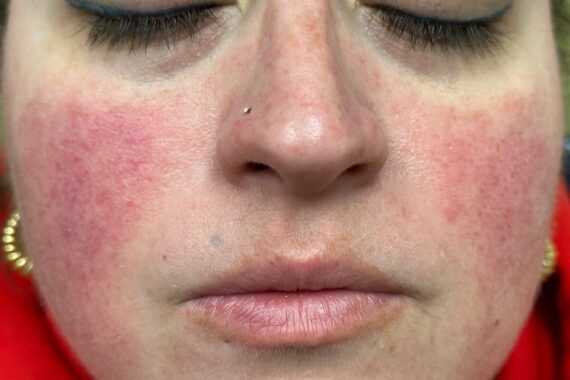
Rosacea is a chronic inflammatory facial dermatosis diagnosed using a phenotype-based approach. The diagnosis is made clinically if there is at least one diagnostic feature — persistent centrofacial erythema or phymatous change (facial skin thickening) — or two major features: flushing/transient erythema, papules/pustules, telangiectasia or ocular features. The rash typically involves the central face (cheeks, nose, chin, forehead), often with sparing of the peri-oral and peri-orbital skin, and comedones are absent, helping distinguish it from acne vulgaris.
Epidemiology
Rosacea is common in UK practice. The prevalence is about 5.46% in the general population, with women more commonly affected than men (about 60% of cases). It has a bimodal age distribution with a smaller peak at 20–30 years and a larger peak at 40–50 years; around 80% of cases are diagnosed after age 30 years and ocular symptoms are recorded in 20% at diagnosis. It is more readily recognised in fair skin but can occur in any skin type.
Diagnosis
Clinical features
Patients commonly report flushing, sensitivity, burning or stinging and dryness. On examination there may be persistent centrofacial erythema, telangiectasia, inflammatory papules and pustules, and sometimes oedema. Erythema may begin intermittently and become fixed over time. Ocular rosacea is important to ask about and may present with gritty or dry eyes, blepharitis, conjunctivitis, recurrent chalazia or, more seriously, keratitis. Phymatous rosacea causes progressive skin thickening, classically rhinophyma.
Investigations
Investigations are not routinely required; diagnosis is usually clinical. Tests are mainly used to exclude differentials or assess complications. If the diagnosis is uncertain, microscopy/culture from pustules is usually unrevealing for rosacea itself, and the absence of comedones or positive microbial findings supports the diagnosis indirectly. Where ocular symptoms are significant, slit-lamp examination in secondary care may show blepharitis, conjunctival inflammation or keratitis. Skin biopsy is rarely needed, but when performed typically shows perifollicular/perivascular inflammatory change rather than a specific primary-care diagnostic abnormality.
Differential diagnosis
The main differentials are acne vulgaris, peri-oral/peri-ocular dermatitis, seborrhoeic dermatitis, lupus erythematosus, steroid-induced rosacea, keratosis pilaris rubra and photodermatoses. Peri-oral/peri-ocular dermatitis is a key mimic, often with papules and pustules around the mouth, nose, or eyes but usually without typical flushing or persistent centrofacial erythema. Acne is suggested by comedones; seborrhoeic dermatitis by greasy scale in typical seborrhoeic sites; lupus by photosensitivity and more sharply demarcated erythema.
Treatment
Management is guided by phenotype. Topical ivermectin, azelaic acid, or metronidazole are appropriate for papulopustular rosacea. If topical treatment fails or disease is more extensive, oral tetracyclines are commonly used, such as doxycycline or lymecycline, usually initially for 3 months. Persistent erythema may respond to topical brimonidine, although adverse effects include rebound erythema/flushing. Topical steroids should be avoided because they can aggravate rosacea. Ocular rosacea requires lid hygiene and ophthalmology referral when severe, sticky eyes fail to respond or keratitis is suspected.
Prognosis
Rosacea is long term and relapsing-remitting, but it can often be controlled well with trigger avoidance, skin-care measures, and phenotype-directed therapy. Persistent vascular change may become less reversible over time, and phymatous change can occur after years of active disease, particularly in men. Ocular disease can threaten the cornea if missed.
Further reading
NICE CKS. Rosacea . Last updated October 2025
Primary Care Dermatology Society. Rosacea . August 2024
British Association of Dermatologists. Rosacea patient information leaflet . April 2022
Spoendlin J et al. A study on the epidemiology of rosacea in the UK . Br J Dermatol 2012;167(3):598-605