

Wholesale GMS contract negotiations may be off the table, says BMA GP committee chair


Exclusive Wholesale GMS contract negotiations may be off the table as they were a ‘Wes Streeting commitment’ rather than a Government one, the leader of English GPs has said.
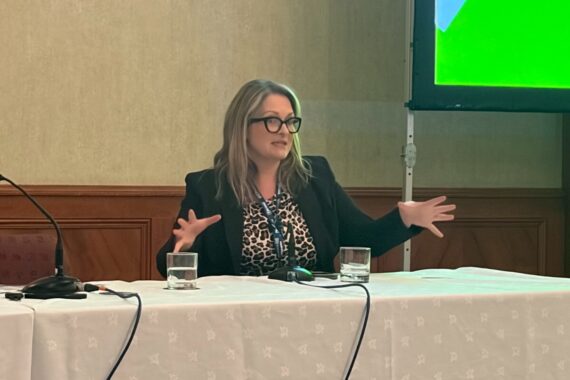
Speaking at Pulse LIVE in Birmingham, Dr Katie Bramall said that the Government is ‘still quite keen’ to move forward with ‘substantive contract reform’, but that this might not happen in the way the union wanted with a wholesale new contract.
Last year former health secretary Wes Streeting had formally committed to renegotiating a ‘completely new’ national GP contract.
Pulse then revealed that the Government would be bringing forward its own proposals for ‘a reform of the GMS contract’, and the BMA’s GP Committee had pushed to start the negotiations immediately, but these have not materialised so far.
Dr Bramall said: ‘The comprehensive spending review was pretty much a year ago, and that’s Treasury’s roadmap for how they’re going to fiscally endure the next three years.
‘They always leave a year before a general election for a bit of a pre-election splurge, where they hold back a bit of money and then spend it at the end, so they can point to nice things on an election trail.
‘But that comprehensive spending review set rules around a limit of 2.8% for the NHS between now and the end of parliament, so for 2025/26, 2026/27 and 2027/28, your investment is locked, and trying to get anything more is going to be impossible.
‘I’ve said to the Department of Health “how does that square with the new contract?” And they have said “well, this was Wes Streeting’s commitment, it wasn’t this Government’s commitment”.
‘I think they’re still quite keen to move forward on substantive contract reform, but not in the way that we would want, and I can see it happening piecemeal.’
She said what the BMA would want to see was ‘scoping discussions’ now, followed by negotiations this Autumn.
‘You have a 90-day pause where you jointly consult other stakeholders over July and August. In September, October, you commence negotiations proper, you put the contract to a vote in the second half of 2027 implementing from April 2028,’ she said.
However, Dr Bramall said that a ‘big barrier’ to this happening was a ‘lack of money’, adding that the ‘biggest red flag’ was the Government-commissioned review of the Carr-Hill formula for GP funding, announced in October last year and meant to last six months.
She said: ‘There’s been silence. My big worry is that we’re looking at a fixed funding envelope where you’re basically taking all the chairs on the deck of the Titanic, throwing it up in the air, and to see where they land, when practices have been managing on established Carr-Hill formulae going back to 2004 based on data that goes back to the 1991 census.
‘I’m not saying it’s fit for purpose, far from it, but you can’t just change everything for the sake of changing it, because you’ll just have even more winners and losers, and even more volatility of practice sustainability. So, that is a big concern for me.’
It comes as the GPC is currently coordinating collective action for practices against this year’s imposed contract and the lack of concessions from the Government around unlimited access.
Dr Bramall said she has ‘been trying to be really pragmatic’, suggesting to the Government that practices should be able to switch off online access at 4pm rather than 6:30pm.
NHS England said that practices have been given the possibility to reach ‘bilateral agreement’ with their ICB when capacity is reached, although only in exceptional circumstances – and practices need to have put systems in place to avoid getting overwhelmed by such demand.
Dr Bramall said: ‘I think a lot of the guidance that is going to come out around exceptional pressures is going to be quite pragmatic and helpful.
‘We’ve got skeleton staff at an ICB level, so I think the risk of breach notices is going to be negligible, and I think they know that.
‘Because they’ve got no staff to manage it, they’re not interested in breaching practices who are genuinely trying to do their best.
‘If you’re taking the piss and you’re switching off at 8.05, that’s a different matter, but, but if you’re literally doing the best you can with what you’ve got, I think they’ll be supported.’
Pulse has contacted the Department of Health and Social Care for comment.
The Government previously responded to a list of proposals put forward by the BMA during the consultation for the 2026/27 GP contract, promising that some of these will be part of future reforms.
Pulse will be back in Birmingham 21-22 June for the Community Pharmacy and General Practice Conference, co-hosted by Cogora. GPs can sign up to attend for free here.

READERS' COMMENTS [6]
Please note, only GPs are permitted to add comments to articles







If I had to guess how this will pan out the car, Hill formula will be used to increase investment in deprived areas who historically maybe in the future may choose to vote labour a little bit like the neighbourhood centres as a predominantly in labour heartlands and deprived areas
Well if Wes’ commitment was not binding I don’t see why a previous GPC commitment should be binding. Let’s cancel online access.
The Government position is outrageous.
There is no new money for primary care investment (and this was before the issues over the defence budget this week). The question now is what can we reasonably do for this fixed amount of money which is essentially less than we do now. That is the negotiation.
Does this mean that we have seen the end of ‘collective bargaining’, and moved to a situation where less money has to be shared out between GP practices now in competition with each other to get money from the same pot individually?
This is a huge backwards step, completely alien to the ideals of a Labour Government or any reasonable Trade Union policy.
So what shall we do about it? – do we start individual negotiations and try and get a settlement before anyone else gets a share of the finite money-pot?
Will this bargaining be open to negotiation by cheaper forms of staff, such as PAs???
I see this government peddling the usual economically illiterate lie about “not having money to spend”. It has the money, it’s a currency issuer, ffs. It’s not a household. What it doesn’t have is the political will to build up the NHS (and public sector) to its glory days. Why? Because successive Govts have not managed to break free from the self-imposed neoliberal rules, and sit idly by, watching the banks create money to finance dodgy scams and inflate asset prices, keeping the City happy.
BMA needs to stop talking within the parameter set by the Govt and in the vocabulary of the economically illiterate Govt negotiators and the captured Treasury. I hope the winds of change soon start blowing.
BTW, glad to see Al Carns making the point that defence and security is not only about MoD spending, but also about having a robust NHS, schools, jobs….otherwise how do you get a healthy, educated people who are willing to defend what they have..